Download
1 / 16
160 likes | 277 Vues
This presentation discusses recent developments in mesoscale data assimilation utilizing the WRF/DART framework, which is supported by NCAR and the US National Science Foundation. Key features include ensemble Kalman filtering, efficient parallelization, and integration of various observation types such as radar and surface data. The presentation highlights the use of localization techniques to improve analyses and forecasts, particularly for convective scales, while addressing model biases. The aim is to enhance high-resolution, short-term predictions in meteorology by accounting for uncertainties and improving observation assimilation strategies.

E N D
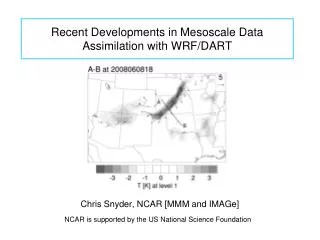
Recent Developments in Mesoscale Data Assimilation with WRF/DART Chris Snyder, NCAR [MMM and IMAGe] NCAR is supported by the US National Science Foundation
Recent Developments in Mesoscale Data Assimilation with WRF/DART Thanks to Soyoung Ha, Terra Thompson (OU), Glen Romine Chris Snyder, NCAR [MMM and IMAGe] NCAR is supported by the US National Science Foundation
WRF/DART • Data Assimilation Research Testbed (DART) • Provides algorithm(s) for ensemble Kalman filter (EnKF) • General framework, used for several models • Parallelizes efficiently to 100’s of processors • Developed by Jeff Anderson and team; see (and download from) http://www.image.ucar.edu/DAReS/DART/ • WRF/DART • WRF-specific interfaces • obs operators: conventional, GPS, radar, surface observations
Why Ensemble DA? • Covariances estimated from ensemble of forecasts • Reflect character, dynamics of recent flow • Don’t depend on assumed balances (e.g. geostrophic) • Analysis ensemble that approximates analysis uncertainty • Reflects location, quality of recent observations • Basis for EF system as well • Little dependence on model • Easy to use new configurations/physics • Update multiple, nested grids simultaneously
Relation of EnKF and Variational Schemes • WRF/DART EnKF ~ WRFDA with alpha CV • … two ways to solve same problem, given same f/c ensemble • WRFDA as released does not generate analysis ensemble • (but see T. Auligné)
Key Element of Ensemble DA • Assume that covariances are small at sufficiently large spatial separation • e.g., Seattle uncorrelated with Miami • Covariance localization • Multiply covariance estimated from ensemble by factor that depends on separation distance • Factor = 0 beyond specified distance: “localization radius” • Main tuning parameter, typically comparable to length scale of flow
Mesoscale Analyses • Model bias limits performance of cycling DA system • Romine et al (2013), real-time convection-permitting forecasts • Torn and Davis (2012), tropical cyclones on large Atlantic domain • Improvements to model of equal importance to details of DA • Surface observations abundant, informative but under-utilized
Assimilation of Surface Observations • Assimilate METAR U10, V10, T2, Td2 over CONUS • 45- and 15-km domains, two-way nested, 3-h cycling • Evaluate against (unassimilated) mesonet observation • Localization radius for EnKF is ~600 km • Significant improvements in: • Surface analyses • 3-h forecast fits to METAR and radiosondes • Error relative to RUC analyses for forecasts < 6 h
Effect of Surface Observations • Analysis increment from assimilation of METAR
Effect of Surface Observations (cont.) • Cross section of analysis increment
Accounting for Model Error • WRF is imperfect. Crucial to account for this in DA scheme. • Multi-physics ensemble (red) • Ensemble with stochastic backscatter (SKEBS; green)
Ensemble DA for Convective Scales • Standard approach, at present: • Assimilate obs from single Doppler radar • Resolution of 1-2 km on small domain, O(200 km x 200 km) • Start with uniform environment (“single sounding”) before radar assimilation • E.g., Dowell et al. (2004), Aksoy et al. (2009), Marquis et al. (2013) • Radius of localization ~ 10 km
Ensemble DA for Convective Scales (cont.) • Would like to incorporate radar obs and convecitve-scale detail into mesoscale analyses • Thompson et al., ongoing work for VORTEX2 case: • Begin by cycling CONUS domain, 15- and 3-km domains, conventional obs • 1-hourly cycles starting day of event • Taking initial and lateral boundary conditions from 3-km domain, assimilate obs from 4 radars on 3- and 1-km domains, 15-min cycling. Decrease localization radius. • Finally, plan to include VORTEX2 obs near time of tornadogenesis
Ensemble DA for Convective Scales (cont.) • 3-km analysis, before radar DA; surface T (left) and water vapor (right) Courtesy T. Thompson
Ensemble DA for Convective Scales (cont.) • Forecasts before (left) and after (right) 4 cycles of radar DA Courtesy T. Thompson
Summary • WRF/DART is applicable to a range of scales and phenomena, with minimal tuning. • Goal for WRF/DART is DA for high-res., short-term prediction. • Key research issues (both ensemble and variational schemes): • accounting within DA for uncertainty/error of forecast model • Identifying and correcting bias in forecast model • Role of land surface (or ocean) in mesoscale DA • DA schemes capable of spanning multiple spatial and temporal scales • Collaboration on these issues is welcome.