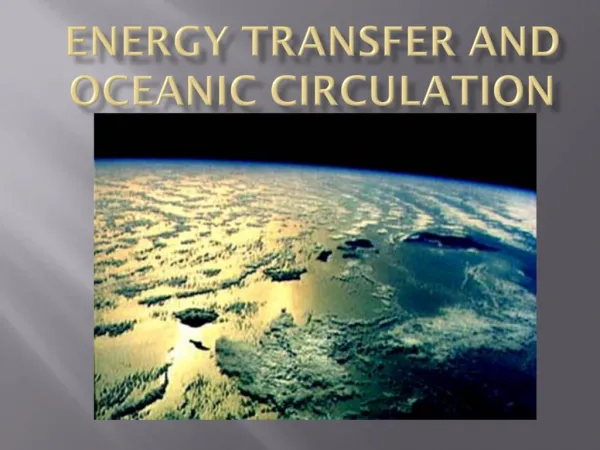
ENERGY TRANSFER AND OCEANIC CIRCULATION
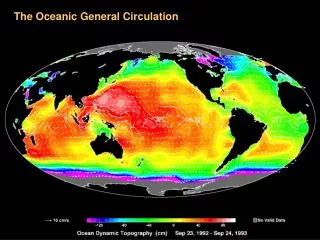
Explore the intricacies of ocean currents and their relationship to energy transfer and oceanic circulation. In the Northern Hemisphere, gyres exhibit a clockwise pattern, while in the Southern Hemisphere, they show an anticlockwise pattern, with the Antarctic Circumpolar Current as a notable exception. These patterns arise from various factors: wind patterns influence current movement, Earth's rotation creates Coriolis effects, landmasses shape flow, and temperature differences affect water density. Dive into the examples and understand how these elements interact in the world's oceans.

ENERGY TRANSFER AND OCEANIC CIRCULATION
E N D
Presentation Transcript
See your map on p15 and notice the following: • In N.Hemisphere gyres have clockwise pattern • In S. Hemispher gyres have an anti-clockwise pattern • Main exception Antarctice Circumpolar Current (west wind drift) Why do you think these patterns occur?
Various factors are responsible: • Currents respond to wind patterns. • Earth’s rotation and coriolis encourage currents to move • Shape of land masses • Temperature differences and influence on water density Think of examples for each of these factors