Dualism and Associationism: Foundations of Modern Psychology and Behavior Science
This overview explores two pivotal concepts in psychology: dualism and associationism. Dualism, articulated by thinkers such as Descartes, separates the mind and body, influencing modern physiology and psychology. In contrast, associationism, rooted in Aristotle’s principles of contiguity, similarity, and contrast, underpins contemporary theories of learning and memory. The work of early reflexologists like Pavlov and Sechenov highlights the role of external stimuli in shaping behavior, challenging the notion that thought alone drives actions. This synthesis lays the groundwork for empirical investigation in the study of mind and behavior.

Dualism and Associationism: Foundations of Modern Psychology and Behavior Science
E N D
Presentation Transcript
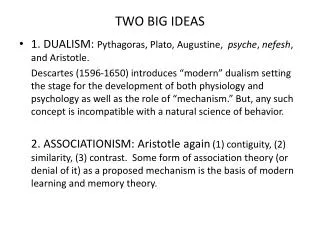
TWO BIG IDEAS • 1. DUALISM: Pythagoras, Plato, Augustine, psyche, nefesh, and Aristotle. Descartes (1596-1650) introduces “modern” dualism setting the stage for the development of both physiology and psychology as well as the role of “mechanism.” But, any such concept is incompatible with a natural science of behavior. 2. ASSOCIATIONISM: Aristotle again (1) contiguity, (2) similarity, (3) contrast. Some form of association theory (or denial of it) as a proposed mechanism is the basis of modern learning and memory theory.
Body as machine, reflexes and involuntary behaviors: The development of experimental neurophysiology and the work of Russian reflexologists—Sechnov, Pavlov, Bekhterev. Soul as mind: voluntary behavior and the British empiricists—introspection and the role of association. The Descartian Agenda
DESCARTES’ LEGACY INTERACTIVE MIND-BODY DUALISM LED TO PARALLEL TRACKS OF INVESTIGATION MIND: METHOD OF INTROSPECTION ISSUE: EPISTEMOLOGY—WHAT DO WE KNOW AND HOW DO WE KNOW IT? PRINCIPAL DIRECTION: EMPIRICISM (ROLE OF EXPERIENCE) AND ASSOCIATION AS MECHANISM GOAL: TO DEVELOP LAWS OF ASSOCIATION BODY: EXPERIMENTAL METHOD: BASED ON STRICTLY MATERIALIST ASSUMPTIONS ISSUE: REDUCTION OF ALL BEHAVIOR TO PHYSIOLOGY PRINCIPAL DIRECTION: EXPLORATION OF REFLEXES; REFLEX ARC AS MECHANISM GOAL: DEVELOP LAWS OF THE REFLEX
REFLEXES OF THE BRAIN (1863)Ivan Sechenov “Thought is generally believed to be the cause of behavior… [but this is] the greatest of falsehoods: [for] the initial cause of all behavior lies, not in thought, but in external sensory stimulation.”
CONDITIONED REFLEXES (1927)Ivan Pavlov “The entire mechanism of thinking consists of the elaboration of elementary associations and the subsequent formulation of chains of association.” “The naturalist must consider only one thing: what is the relation of this or that external reaction of the animal to the phenomena of the external world.” “…natural science is under obligation to determine only the precise connection..between a natural phenomenon and the response of the living organism to that phenomenon…”