Teacher definition:
110 likes | 231 Vues
This text explores the concept of imperialism, focusing on how industrialized nations sought dominance over non-industrialized countries for economic gain. It delves into key motivations for European colonialism in Africa and Asia, including the pursuit of natural resources, markets for goods, and a sense of duty to "civilize" non-White peoples. The Berlin Conference of 1884 is highlighted as a significant moment in the scramble for African territory, where major powers divided the continent, leading to European control over 90% of Africa by 1902.


Teacher definition:
E N D
Presentation Transcript
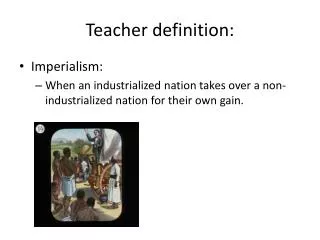
Teacher definition: • Imperialism: • When an industrialized nation takes over a non-industrialized nation for their own gain.
Reasons for Imperialism • Why do you think European countries took over other nations in Africa and Asia? • Remember the stuff we’ve covered this unit. • Write your responses under “your reasons.”
Why Colonize Africa? • Natural Resources • Africa is one of the last “unclaimed” areas of the world. • Market for industrialized goods. • Europeans were already familiar due to Slave Trade and earlier colonization on the coast. • White Man’s Burden: Europeans felt it was their duty to civilize the non-White peoples of the world.
Berlin Conference • Otto von Bismarck, German Chancellor, invited the following countries to work out a policy for dividing African territory in 1884: • Austria–Hungary • Belgium • Denmark • France • the United Kingdom • Italy • Netherlands • Portugal • Russia • Spain • Sweden-Norway (union until 1905) • Ottoman Empire • United States
Berlin Conference • Otto von Bismarck, German Chancellor, invited the following countries to work out a policy for dividing African territory in 1884: • Austria–Hungary • Belgium • Denmark • France • the United Kingdom • Italy • Netherlands • Portugal • Russia • Spain • Sweden-Norway (union until 1905) • Ottoman Empire • United States • Who is not on this list?
Belgium Germany Spain France Great Britain Italy Portugal Independent
Results: • European scramble for territory speeds up. • War between European powers over African territory was avoided. • By 1902, 90% of Africa was owned by European powers. Belgium Germany Spain France Great Britain Italy Portugal Independent