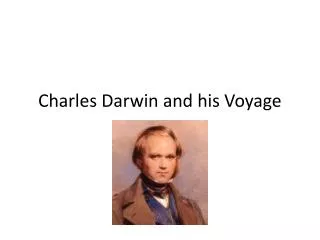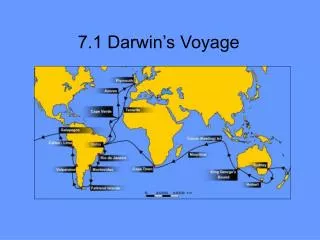
Darwin’s Voyage
Darwin’s Voyage. Galapogas Islands’ organisms. Blue Footed Booby. Giant Tortoises. Iguana. Sally Light Foot Crab. Similarities and Differences. Cormorant. Galapagos Cormorant. Galapagos Iguana. Iguana. Galapogas Finches. Evolution.
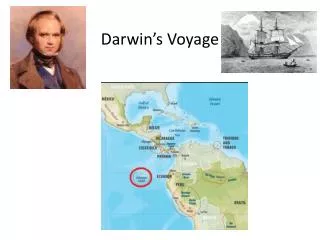

Darwin’s Voyage
E N D
Presentation Transcript
Galapogas Islands’ organisms Blue Footed Booby Giant Tortoises Iguana Sally Light Foot Crab
Similarities and Differences Cormorant Galapagos Cormorant Galapagos Iguana Iguana
Evolution • Darwin thought that species gradually changed over many generation and become better adapted to the new conditions.
Natural Selection • The process by which individuals that are better adapted to their environment are more likely to survive and reproduce than other members of the same species.
Overproduction • Most species produce far more offspring than can possibly survive.
Competition • Organisms compete for resources like food, water, and space in order to survive and reproduce.
Variations • Differences between individuals of the same species.
Selection • Over a long period of time, natural selection can lead to evolution. Helpful variations gradually accumulate in a species while unfavorable ones disappear.
The case of the English Peppered Moth • The industrial revolution of the 1700’s turned the trees black which favored the black variety.
New Species Formation • A new species can form when a group of individuals remains separated from the rest of its species long enough to evolve different traits. Kaibab Squirrel Abert Squirrel
Continental Drift • Hundreds of millions of years ago, a supercontinent existed named Pangea. When the continents drifted apart, organisms became separated and evolved to survive in their new environment.