Understanding Electric Potential and Fields in Various Coordinate Systems
This document explores electric potential and fields, providing methods to compute them using Gauss’s Law and integration techniques. It addresses continuous charge distributions, with examples including finding the electric field from given potentials in Cartesian and spherical coordinates. The discussion extends to potential calculations for specific charges and geometries—like a finite line charge and a uniformly charged sphere—focusing on different coordinate systems such as Cartesian, cylindrical, and spherical. Learn how to navigate complex electric scenarios effectively.

Understanding Electric Potential and Fields in Various Coordinate Systems
E N D
Presentation Transcript
Electric Potential (III) • - Fields • Potential • Conductors
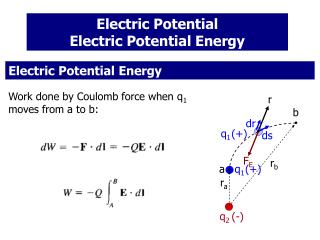
Potential and Continuous Charge Distributions • We can use two completely different methods: • Or, Find from Gauss’s Law, then…
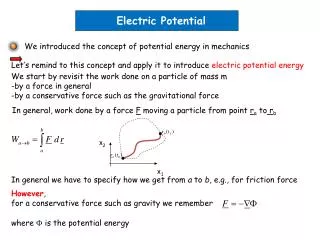
Potential and Electric Field • Since therefore, we have (in Cartesian coords): Hence:
Ex 1b:Given V=(10/r2)sinθcos (spherical coords) • a) find E. • b) find the work done in moving a 10μC charge from A(1, 30o, 120o) to B(4, 90o, 60o).
There are many coordinate systems that can be used: • Bipolarcylindrical, bispherical, cardiodal, cardiodcylindrical, Cartesian, casscylindrical, confocalellip, confocalparab, conical, cylindrical, ellcylindrical, ellipsoidal, hypercylindrical, invcasscylindrical, invellcylindrical, invoblspheroidal, invprospheroidal, logcoshcylindrical, logcylindrical, maxwellcylindrical, oblatespheroidal, paraboloidal, paracylindrical, prolatespheroidal, rosecylindrical, sixsphere, spherical, tangentcylindrical, tangentsphere, and toroidal.
Ex 2: Find the potential of a finite line charge at P, • AND the y-component of the electric field at P. P r d dq x L
Example: The Electric Potential of a Dipole y a a x P -q +q Find: a) Potential V at point P along the x-axis. b) What if x>>a ? c) Find E.
Example: Find the potential of a uniformly charged sphere of radius R, inside and out. R
Uniformly Charged Sphere,radius R E r R V r R
Example: Recall that the electric field inside a solid conducting sphere with charge Q on its surface is zero. Outside the sphere the field is the same as the field of a point charge Q (at the center of the sphere). The point charge is the same as the total charge on the sphere. Find the potential inside and outside the sphere. +Q R
Solution (solid conducting) • Inside (r<R), E=0, integral of zero = constant, so V=const • Outside (r>R), E is that of a point charge, integral gives • V=kQ/r
Solid Conducting Sphere,radius R E r R V r R
Quiz A charge +Q is placed on a spherical conducting shell. What is the potential (relative to infinity) at the centre? +Q • keQ/R1 • keQ/R2 • keQ/ (R1 - R2) • zero R1 R2
Calculating V from Sources: • Point source: (note: V0 as r ) or ii) Several point sources: (Scalar) iii) Continuous distribution: OR … I. Find from Gauss’s Law (if possible) II. Integrate, (a “line integral”)