CS 175 – Week 1 Point Cloud Basics A cquisition and Data Structures
170 likes | 322 Vues
This week, we explore the fundamentals of point clouds, including their acquisition from 3D scans, meteorological data, geological experiments, and numerical simulations. We will delve into point properties defined by dimensions (e.g., 1.5D, 2D, 3D), highlighting how measurement errors can affect data quality. You will learn about essential data structures necessary for storing and accessing point values, focusing on octrees as a hierarchical structure for efficient neighbor searches. Additionally, we will address algorithms for finding neighbors within a radius and the k-nearest neighbors.


CS 175 – Week 1 Point Cloud Basics A cquisition and Data Structures
E N D
Presentation Transcript
CS 175 – Week 1Point Cloud BasicsAcquisition and Data Structures
Data Sources • point clouds generated by • measurements • 3D scan, meteorology, geology • experiments • numerical simulation • evaluation
Point Properties • dimension • 1.5D – function values along a line • 2D – positions in the plane • 2.5D – function values in the plane • 3D – positions in 3D • nD – multi-modal data • measurement error
Data Structures • Requirements • access point values (coordinates) • find neighbours • within a certain radius “r” • the “k” nearest neighbours
Storing Values • vector of values • values per element • unique index for every point • convenient access: v[i].{x,y,z} • but: hard to find neighbours
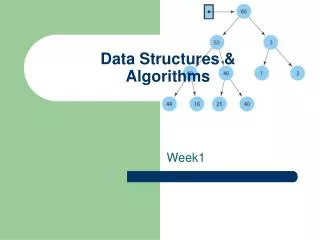
Octrees • Hierarchical spatial data structure • divide-and-conquer • binary subdivision
Octrees • each node contains • dimensions [xmin,xmax] x [ymin,ymax] x [zmin,zmax] • pointers to eight children • empty for leaf-nodes • unique label e.g., p-adic number, p=2d+1
0000 0000 0001 0002 0001 0002 0011 0021 0012 0022 0021 0022 0012 0121 0221 0112 0212 0121 0212 0221 0112 1121 2121 1121 2121 Octrees • 1D example 0011
Points and Octrees • store points in an octree • points: reference to node (label) • leaf nodes: list of points (indices) • subdivision criterion • maximum number of points
Creating the Octree • loop over all points • find leaf that contains it • O(l), l = octree depth • add point to this leaf-node
Creating the Octree • add point to leaf-node • add point-index to list • store node-label in point • if list-size exceeds maximum • split this node
Creating the Octree • split node • create sub-nodes • assign points in list to sub-nodes • update node-references for points
Algorithms • finding neighbours of a point • within certain radius “r” • the “k” nearest • two-step process • create queue of candidate nodes • consider points contained therein
Neighbours within Radius • queue q of nodes • traverse octree, e.g. depth first • add leaf-node to q if dmin< r • for all nodes in q • for all points in the node • if d < r then add as neighbour
k Nearest Neighbours • priority queue q1(dmin) of nodes • priority queue q2(d) of points • add root-node to q1 • while q1 not empty, get front • if not leaf-node, add children to q1, continue • if node close enough ( dmin< q2[k] ) • add all points in node to q2 • take first k elements of q2 as neighbours
Beyond Octrees • non-standard octrees • not axis-aligned • no uniform subdivision • binary space-partioning (BSP) trees • recursive subdivision witharbitrary planes
What’s Next? • Thursday • 3D scanning presentation • field trip – scan Tech spots • Homework • scout suitable sites • make (digital) photos