Understanding Forces: Push, Pull, and Newton's Laws in Physics
Dive into the essential concepts of forces in physics with a focus on push and pull dynamics. Explore vector properties, including contact and field forces such as friction, tension, gravity, and magnetism. Learn how to draw free body diagrams, calculate net force, and differentiate between balanced and unbalanced forces. Uncover the implications of Newton's 2nd Law, where force equals mass times acceleration, and how weight differs from mass. Gain insights into the fundamentals of forces and their impact on motion.


Understanding Forces: Push, Pull, and Newton's Laws in Physics
E N D
Presentation Transcript
FORCES (insert scary music here)
I. Forces • A push or pull on an object. • It is a vector • All vector rules apply • Measured in Newtons (N) • Why? • Named after Bob Newton
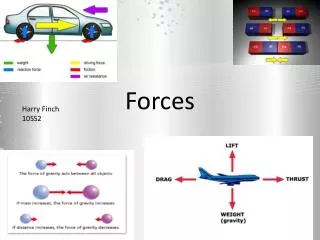
B. Contact Forces • When the applied force is touching the object. • Friction • Tension • Wind Resistance
C. Field Forces • When a force is not touching. • Magnetism • Gravity • Electrical
D. Free Body Diagram • A drawing of the forces acting on an object. • Ex. 2 student are pulling on a rope with 5 N of force each. 5 N 5 N
N N E. Net Force • Net Force • Total force on an object • Use vector addition to find net force Fnet Ffriction Fpull W
F. Balanced Force • Balanced Forces • forces acting on an object that are opposite in direction and equal in size • no change in velocity
Example • Three Dogs fight over a toy. One pulls with 7 N E, one pulls 10 N W, and the other pulls with 4 N S. What is the net force on the toy? 7 N 10 N 4 N
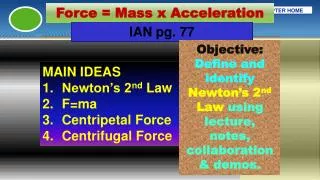
II. Newton’s 2nd Law • F=ma • F = force (N) • m = mass (kg) • a = acceleration (m/s2) • As force increases, acceleration increases. • The more massive something is the more force is required.
Newton’s 2nd Law • If there is no net force, there is no acceleration. • If there is an unbalanced force, there must be an acceleration.
B. Weight • Weight is the pull of gravity on an object. • Weight and mass are not the same thing. • Weight is a force • F = ma • a = 9.8 m/s2 only on Earth = g • So, W = mg • Calculate YOUR weight on Earth