Reaction rates in the Laboratory
310 likes | 434 Vues
This document explores key nuclear reactions, specifically the slowest reaction in the CNO cycle, 14N(p,γ)15O, and its implications on stellar evolution and cluster ages. It details experimental setups such as the underground LUNA laboratory and accelerator techniques for measuring low cross sections. The material presents the importance of detecting reaction rates via advanced detectors and Faraday cups, and discusses examples of various proton-induced reactions using radioactive beams, emphasizing the challenges faced in experimental nuclear astrophysics.


Reaction rates in the Laboratory
E N D
Presentation Transcript
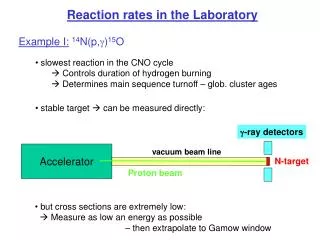
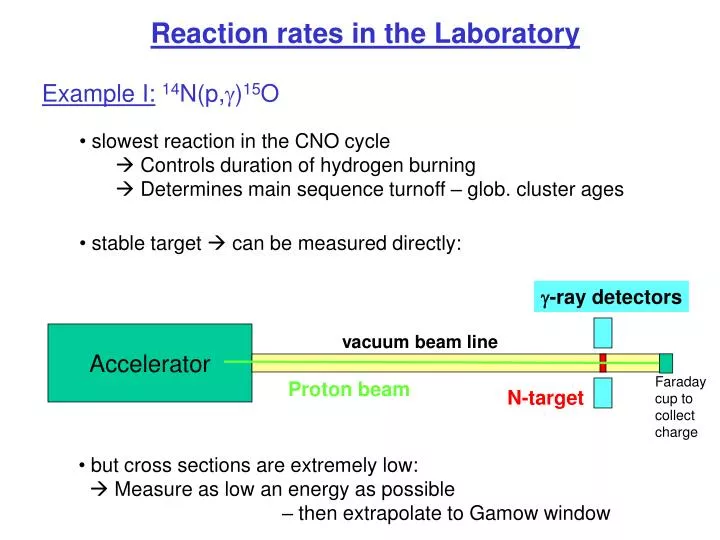
Reaction rates in the Laboratory Example I:14N(p,g)15O • slowest reaction in the CNO cycle • Controls duration of hydrogen burning • Determines main sequence turnoff – glob. cluster ages • stable target can be measured directly: g-ray detectors Accelerator vacuum beam line Faraday cup to collect charge Proton beam N-target • but cross sections are extremely low: • Measure as low an energy as possible – then extrapolate to Gamow window
Calculating experimental event rates and yields beam of particles hits target at rest area A j,v thickness d assume thin target (unattenuated beam intensity throughout target) Reaction rate (per target nucleus): Total reaction rate (reactions per second) with nT: number density of target nucleiI=jA : beam number current (number of particles per second hitting the target) note: dnTis number of target nuclei per cm2. Often the target thickness is specified in these terms.
Events detected in experiment per second Rdet e is the detection efficiency and can accounts for: • detector efficiency (fraction of particles hitting a detector that produce a signal that is registered) • solid angle limitations • absorption losses in materials • energy losses that cause particles energies to slide below a detection threshold • …
14N(p,g) level scheme Gamow window0.1 GK: 91-97 keV g-signature of resonance6791 keV g0 Direct gs capture~7297 keV + Ep
LUNALaboratory Underground for Nuclear Astrophysics(Transparencies: F. Strieder http://www.jinaweb.org/events/tucson/Talk_Strieder.pdf) Gran Sasso Mountain scheme 1:1 Mio cosmic ray suppression
Results: GamowWindow Formicola et al. PLB 591 (2004) 61 New S(0)=1.7 +- 0.2 keVb (NACRE: 3.2 +- 0.8)
New Resonance ? Resonance claim and TUNL disproof
Example II: 21Na(p,g)22Mg problem: 21Na is unstable (half-life 22.5 s) solution: radioactive beam experiment in inverse kinematics: 21Na + p 22Mg + g thick 21Na production target hydrogen target 22Mg products Accelerator I Accelerator 2 p beam 21Na beam g-detectors ionsource particleidentification difficulty: beam intensity typically 107-11 1/s (compare with 100 mA protons = 6x10¹⁴/s) so far only succeeded in 2 cases: 13N(p,g) at Louvain la Neuve and 21Na(p,g) in TRIUMF (for capture reaction)
Results Result for 206 keV resonance: S. Bishop et al. Phys. Rev. Lett. 90 (2003) 2501
Example III: 32Cl(p,g)33Ar Shell model calculations Herndl et al. Phys. Rev. C 52(1995)1078 proton width strongly energy dependent rate strongly resonance energy dependent
H. Schatz NSCL Coupled Cyclotron Facility
Fast radioactive beams at the NSCL: • low beam intensities • Impure, mixed beams • high energies (80-100 MeV per nucleon) (astrophysical rates at 1-2 MeV per nucleon) great for indirect techniques • Coulomb breakup • Transfer reactions • Decay studies • …
H. Schatz Setup Focal plane:identify 33Ar S800 Spectrometer at NSCL: 34Ar Beamblocker 33Ar 33Arexcited 34Ar d Plastic People: Plastictarget 34Ar D. Bazin R. Clement A. Cole A. Gade T. Glasmacher B. Lynch W. Mueller H. Schatz B. Sherrill M. VanGoethem M. Wallace Radioactive 34Ar beam84 MeV/u T1/2=844 ms(from 150 MeV/u 36Ar) SEGAGe array(18 Detectors)
S800 Spectrometer SEGA Ge-array
H. Schatz with experimental data shell model only x 3 uncertainty x10000 uncertainty New 32Cl(p,g)33Ar rate – Clement et al. PRL 92 (2004) 2502 Doppler corrected g-rays in coincidence with 33Ar in S800 focal plane: g-rays from predicted 3.97 MeV state stellar reaction rate reaction rate (cm3/s/mole) 33Ar level energies measured: 3819(4) keV (150 keV below SM) 3456(6) keV (104 keV below SM) temperature (GK) Typical X-ray burst temperatures
NSCL ReA3 Fast beams Gas cell
Science with CCF reaccelerated beams and p-process … Rates in pps >108 direct (p,g) 107-8 106-7 direct (p,a) or (a,p)transfer 105-6 104-5 (p,p), some transfer 102-4 Up to here: For indirect measurements: many For direct measurements: some important rates • Capabilities: • sufficient beam intensities for many important measurements • all beams available once system commissioned • probably very good beam purity • none of the measurements identified can be performed at another facility as of now
ReA12 and Experimental Areas • A full suite of experimental equipment will be available for fast, stopped and reaccelerated beams • New equipment • Stopped beam area (LASERS) • ISLA Recoil Separator • Solenoid spectrometer • Active Target TPC
Science with reaccelerated beams at FRIB Direct measurementsfor many (a,g) reactions in p-process Rates in pps 10>10 109-10 108-9 107-8 All reaction rates can beindirectly measuredincluding 72Kr waiting point 106-7 105-6 104-5 102-4 most reaction rates up to ~Sr can bedirectly measured All reaction rates up to ~Ti can be directly measured Very strong nuclear astrophysics science case