Improving Linac3 Energy Measurements: Challenges and Solutions
This document discusses the ongoing challenges in measuring the energy of Linac3 and proposes potential solutions for enhancing measurements, including considerations for debuncher setup and energy spread. The study addresses issues related to measurement specifications, user accessibility, cost, and the potential consolidation of existing resources. It emphasizes the need for collaboration among various teams and sets timelines for research, solution development, and eventual installation. The aim is to enhance measurement accuracy while minimizing perturbation to existing systems.

Improving Linac3 Energy Measurements: Challenges and Solutions
E N D
Presentation Transcript
Should we study if we need a better Linac3 energy measurement? LBS for Linac3 R Scrivens, 1/10/2013 – NSWG/LIU-Ions
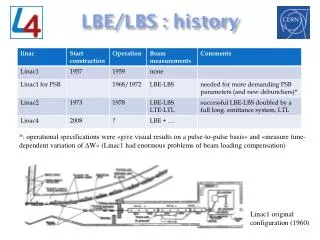
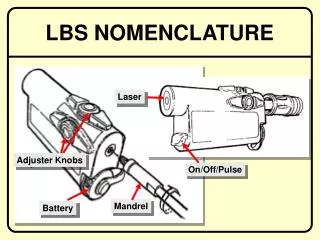
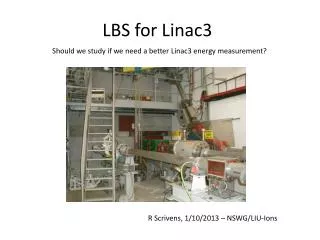
Presently, it is a classical spectrometer line. • Using the bending edge angle focusing for object(slit) – image(SEMGrid) plus dispersion. • It is located at the hand over point of Linac2-PSB. • Ions must be sent through 40 m (otherwise unused for ions) transfer line, including 30 m of common line with Linac2. • Requires specialist set ups, unorthodox controls, PSB+LEIR synchronisation, maintenance of ION user in PSB. • Only 1 person ever dares to try and make measurements. It takes ~2 days to get everything working! • Systematic and reference measurements are very rare because of these difficulties. E.g. we have no before and after measurement of the tank 2 phase change. • Dedicated MD time for LEIR (no ions to LEIR during measurements). • Recent consolidation was put off because Linac4 was renovating the line – this is no longer the case. • Linac3 has an ITFS line, but it is before the last debuncher where the energy spread is set.
The LBS “inter wire” resolution is DP/P=8x10-4 . If this is critical we need 4x better resolution. CERN-ATS-Note-2013-035 MD
Questions a study should address: • MAIN QUESTION: Propose a solution to measure the Linac3 energy (relative mean and spread), and must allow setting up of the debuncher(wider energy spread and mean energy range). • Considering (in order of priority) • Meets the specification. • Easy to use (for reference measurements). • Minimises perturbation to PSB and LEIR. • Is affordable.
Just consolidate what we have in present location? • Recover similar spectrometer magnets from Linac2? • New power convertors? • Are specifications sufficient and flexible enough for LIU-Ions? • Is bunch shape tomography a better / cheaper option (as Linac4 will do). • Is LEIR Schottkya better measurement – is this instrument maintained? Is this a way to set up beams? • Move the instrument to an area dedicated to ion beams. • Make a brand new spectrometer line in a optimal location?
Time Line • 2014 – Start studying these questions. Requires input from many groups, plus design/integration support. • Mid 2015 – solution must be fixed (including funding and personnel). • Mid 2015 – end 2016 : Production (assuming major changes). • 2017 Installation during Linac4-PSB connection.