GDP
GDP. Measuring the Macroeconomy. Early economists believed it would regulate itself “Hands off” Great Depression convinced them to monitor and try to prevent. National Income and Product Accounts.

GDP
E N D
Presentation Transcript
Measuring the Macroeconomy • Early economists believed it would regulate itself • “Hands off” • Great Depression convinced them to monitor and try to prevent
National Income and Product Accounts • National Income Accounting – system that collects stats on production, income, investment and savings. • NIPA • Compiles data • U.S. Department of Commerce • GDP
Gross Domestic Product • The dollar value of all final goods and services produced within a country’s borders in a given year. • Dollar Value – selling prices of all goods and services • Final Goods and Services – Finished product the consumer receives • Intermediate Goods – used to produce final • Country’s borders – Includes car made in Ohio by Japanese company, but not made in Brazil by an American company. • Given Year – House built in 1982 counted in that year’s GDP
GDP • Gross = entire; whole • Domestic = within a country’s borders • Product = good or service • 1982 House: real estate agent’s fee for reselling would be included in GDP • Lumber, Nails, Shingles, Windows counted? • No, they are intermediate goods
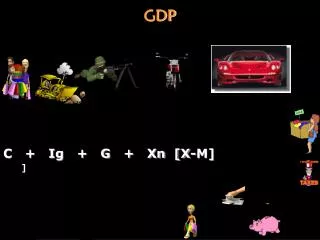
Expenditure Approach • Calculate GDP by 4 categories: • Private Consumption • Business investments • Government spending • Net exports minus imports • GDP = C + I + G + (X – M)
Consumer Goods • Durable Goods – refrigerators, cars, and DVD players • Nondurable Goods – food, light bulbs, sneakers
Income Approach • Better accuracy • Add up all income earned in the economy • A house may generate $150,000 in a sale • This # is the combined incomes of the people who provided goods and services to build the house
Nominal vs. Real • Nominal GDP – Measured in current prices • Real GDP – Expressed in constant, or unchanging, prices • Increase in prices appears to make GDP rise, but output has not
Limitations of GDP • Not a perfect “yardstick” • Doesn’t measure quality of life like leisure and safety • Nonmarket Activities – goods and services people do for themselves • Caring for children, mowing the lawn, cooking dinner, washing the car • Underground Economy – not reported to the gov’t and not counted in GDP • Black Market: drugs, weapons, stolen cars, exotic animals, illegal gambling • “Under the Table”
Other Income and Output Measures • Gross National Product (GNP) • Annual income earned by U.S. owned firms and residents • Does not account for depreciation, the loss of value of capital equipment that results from normal wear and tear
Measurements • Net National Product – measure of output after adjustment for depreciation • National Income – subtract sales and excise taxes from NNP • Personal Income – how much pretax income businesses pay to households after reinvesting • Disposable Personal Income - $ people can spend after taxes
Influences on GDP • Price Level – Average of all prices in the economy • Aggregate Supply – total amount of goods and services in the economy available at all possible price levels Aggregate Supply Price Level Real GDP
Aggregate Demand Wealth Effect – falling prices increase wealth and demand • Aggregate Demand – amount of goods and services in the economy that will be purchased at all possible price levels Price Level Aggregate Demand Real GDP
Equilibrium • AS and AD work the same way as Supply and Demand • Aggregate means “total amount” Aggregate Supply Price Level Aggregate Demand Real GDP