Understanding Boolean Algebra in Digital Circuitry and Computer Systems
Boolean Algebra is a fundamental mathematical discipline used in the design and analysis of digital circuitry in computers and other systems. This framework employs basic logical operations such as AND, OR, NOT, XOR, NAND, and NOR. Each operation has specific truth values and operations represented through symbols. The principles of Boolean Algebra are based on several postulates and laws, including commutative, distributive, associative laws, and DeMorgan's Theorem. Understanding these operations is essential for effective digital circuit design and implementation.

Understanding Boolean Algebra in Digital Circuitry and Computer Systems
E N D
Presentation Transcript
Boolean Algebra D. W. ChathurikaPavithrani UvaWellassa University
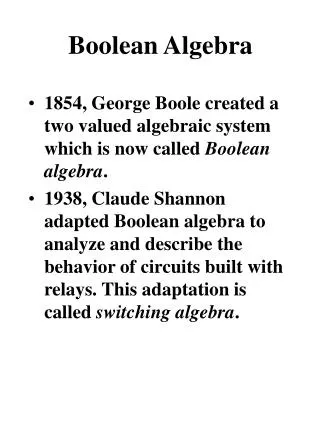
The digital circuitry in digital computers and other digital systems is designed, and its behavior is analyzed, with the use of mathematical discipline known as Boolean Algebra.
Basic Logical Operations • AND • Represented by a dot or by the absence of an operator • OR • Represented by a Plus symbol • Not • Represented by a Bar over the variable
Logical AND Operation • 0 . 0 = 0 • 0 . 1 = 0 • 1 . 0 = 0 • 1 . 1 = 1
Logical OR Operation • 0 + 0 = 0 • 0 + 1 = 1 • 1 + 0 = 1 • 1 + 1 = 1
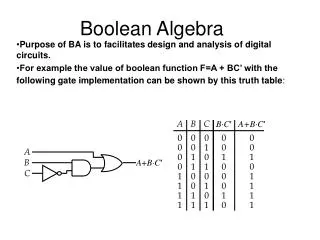
D = A + (B’ + C) D equals to 1 if A is 1 or if both B = 0 and C = 1
Logical XOR Operation • 0 . 0 = 0 • 0 . 1 = 1 • 1 . 0 = 1 • 1 . 1 = 0
Logical NAND Operation • 0 . 0 = 1 • 0 . 1 = 1 • 1 . 0 = 1 • 1 . 1 = 0
Logical NOR Operation • 0 . 0 = 1 • 0 . 1 = 0 • 1 . 0 = 0 • 1 . 1 = 0
A + B . C = A + (B.C) = A + BC
A NAND B = NOT(A AND B) = (AB)’ A NOR B = NOT (A OR B) = (A + B)’
Basic Postulates Commutative laws Distributive laws Identity elements Inverse elements
Other Identities Associative Laws DeMorgan’s Theorem
A NOR B = A’ AND B’ A NAND B = A’ OR B’