Cathode Strip Chambers
120 likes | 252 Vues
This document outlines the collaborative efforts in testing and developing DSP modules for Cathode Strip Chambers by researchers from the University of California, Irvine, and Brookhaven National Laboratory. Key aspects include the use of a PC-based National Instruments VME interface, Microsoft Visual C++, and a detailed overview of Read-Out Drivers (RODs), including bandwidth specifics, configuration, and calibration constants. Future plans highlight the readiness for production, ongoing DSP software development, and scheduled installations.


Cathode Strip Chambers
E N D
Presentation Transcript
Cathode Strip Chambers University of California, Irvine D. Hawkins, A. Lankford, M. Medve, S. Pier, M. Schernau, S. Shim, D. Stoker Brookhaven National Laboratory A. Gordeev, V. Gratchev, S. Junnarkar, A. Kandasamy, P. O’Connor, V. Polychronakos, V. Tcherniatine
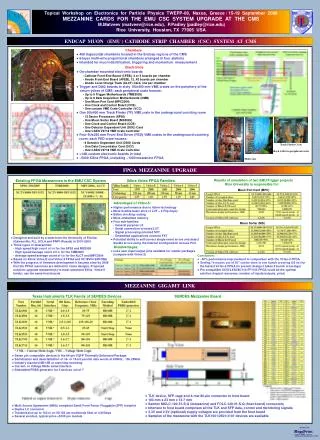
Testing in the Lab • PC-based National Instruments VME interface • Microsoft Visual C++ • PC-DAQ • Joint test of On-Chamber electronics • DSP debugging with Texas Instruments Code Composer Studio
ROD Facts • Number of RODs:16 in initial stage, 32 final stage • Number of ROD crates: 2 • One partition per endcap • Fragment size: 200 Bytes (with safety factor of 5) • Input bandwidth: 1.1 Gbytes/s/ROD • Output bandwidth: 20 Mbytes/s/ROD • Reset times: 3 s Powerup from Flash memory
Configuration data size • FPGA: 1.5 Mbytes per ROD • DSP: 1 Mbyte per ROD • Calibration constants: 9.6 kBytes per ROD • To be loaded over VME backplane
Future Plans • Fully functional ROD ready for production at the end of 2003 • Flexible output format due to DSP code written in C • Continue ROD DSP software development • Want two ROD crates and RCCs by March 2003 for software development and system integration tests
Future Plans • Beam test in 2003 possible • We expect a combined test beam run with other detectors in 2004 • Use in precommissioning of small wheels on surface during late 2005 possible • Installation in USA15 scheduled for May 2006