Download
1 / 1
20 likes | 134 Vues
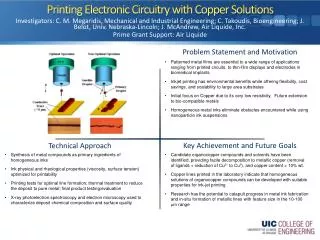
This study investigates the use of homogeneous metal inks for inkjet printing of copper, aiming to enhance flexibility, cost savings, and scalability in applications such as printed circuits, thin-film displays, and biomedical implants. The focus is on the synthesis of organocopper compounds that optimize ink properties for printability and allow for efficient thermal treatment to create pure metal deposits. The research explores techniques like X-ray photoelectron spectroscopy and electron microscopy for analyzing the final product, revealing significant progress in metal ink fabrication and the formation of fine metallic lines.

E N D
Printing Electronic Circuitry with Copper Solutions Investigators: C. M. Megaridis, Mechanical and Industrial Engineering; C. Takoudis, Bioengineering; J. Belot, Univ. Nebraska-Lincoln; J. McAndrew, Air Liquide, Inc. Prime Grant Support: Air Liquide • Patterned metal films are essential to a wide range of applications ranging from printed circuits, to thin-film displays and electrodes in biomedical implants • Inkjet printing has environmental benefits while offering flexibility, cost savings, and scalability to large area substrates • Initial focus on Copper due to its very low resistivity. Future extension to bio-compatible metals • Homogeneous metal inks eliminate obstacles encountered while using nanoparticle ink suspensions • Synthesis of metal compounds as primary ingredients of homogeneous inks • Ink physical and rheological properties (viscosity, surface tension) optimized for printability • Printing tests for optimal line formation; thermal treatment to reduce the deposit to pure metal; final product testing/evaluation • X-ray photoelectron spectroscopy and electron microscopy used to characterize deposit chemical composition and surface quality • Candidate organocopper compounds and solvents have been identified, providing facile decomposition to metallic copper (removal of ligands + reduction of Cu2+to Cu0), and copper content > 10% wt. • Copper lines printed in the laboratory indicate that homogeneous solutions of organocopper compounds can be developed with suitable properties for ink-jet printing • Research has the potential to catapult progress in metal ink fabrication and in-situ formation of metallic lines with feature size in the 10-100 m range