Heredity
Heredity is the process by which genetic material is passed from parents to offspring, influencing traits like skin color, eye color, and height. At its core is DNA, which carries this information. Traits are controlled by genes, with variations known as alleles. Asexual reproduction produces identical clones, while sexual reproduction increases genetic diversity. Dominant and recessive alleles play a crucial role in determining traits such as eye color. Punnet squares are tools used to predict the traits of offspring from parental alleles, aiding in genetic understanding.


Heredity
E N D
Presentation Transcript
DNA • DNA stores all of the information that makes each of us who we are. • Controls the traits we possess • Trait=Physical Characteristic • Examples include skin color, eye color, height, eye sight, hair color, etc....
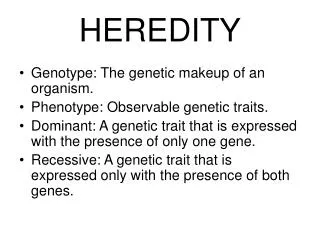
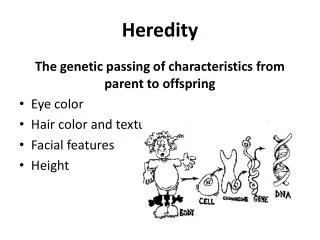
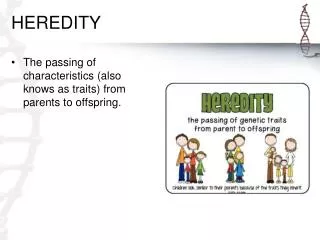
Heredity • Heredity= The passing of genetic material from parent to offspring. • Gene= Basic unit of heredity; a group of DNA • Inherited traits are controlled by genes • Example: eye color • Allele= Variation of a gene • Example: Blue eyes or Brown Eyes
Asexual Reproduction • Reproduction that occurs when one organism produces offspring with identical DNA as the parent • Advantage: Quick and only requires one organism to reproduce. • Disadvantage: All offspring are identical or “clones” of the parent, no genetic diversity
Sexual Reproduction • Reproduction that occurs between two organisms that result in the offspring getting DNA from both parents • Advantages: Greater genetic diversity • Disadvantages: Takes two organisms and more energy.
Dominant and Recessive Alleles • In sexual reproduction, offspring receive one allele from each parent. • One allele is dominant to the other allele • The dominant allele is always expressed when present in an offspring • Example: Eye Color • Brown is dominant=B • Blue is recessive=b • If one brown allele is present the offspring will have brown eyes
Punnet Squares • Punnet Squares are used to predict the traits of the offspring between two parents based on their alleles. Parent 1 Parent 2
Punnet Squares continued Parent 1 Parent 2
Punnet Squares Continued Parent 1 Parent 2
Punnet Squares Continued Parent 1 Parent 2
Punnet Squares Continued Parent 1 Parent 2
Punnet Squares Continued Parent 1 Parent 2
Punnet Squares Continued Parent 1 Parent 2