Understanding Synthesis, Decomposition, Displacement, and Combustion Reactions in Chemistry
This chapter delves into the fundamental types of chemical reactions, including synthesis, decomposition, single displacement, double displacement, and combustion. It provides clear examples for each type, such as how substances combine in synthesis reactions (e.g., forming NaCl from Na and Cl) and how they break apart in decomposition reactions (e.g., the breakdown of HgO into Hg and O2). It also explores the mechanics of electrolysis and combustion, illustrating the importance of oxygen and the conditions affecting the outcomes of reactions. Learn to recognize patterns and predict products of various reactions.

Understanding Synthesis, Decomposition, Displacement, and Combustion Reactions in Chemistry
E N D
Presentation Transcript
Reaction Types Chapter 6.2
C C C C C C C C C C C C C C C C + O O O O O O O O O O O O O O O O O O O O O O O O O O O O O O O O Synthesis reactions combine substances Example C + O2 CO2 General: A + B AB
Synthesis Example: NaCl Na + Cl General: A + B AB
Hg Hg Hg Hg + O O O O Decomposition reactions break substances apart Example 2HgO 2 Hg + O2 General: AB A + B
Decomposition Examples • Digestion (breaking down food molecules into simpler substances) • Electrolysis of water • Electrolysis—the process by which an electric current is used to produce a chemical reaction • 2H20 (with electricity) 2H2 + O2
+ + Cl Cl Cl Cl Zn Zn Cu Cu In single displacement reactions, elements trade place! Example: CuCl2 + Zn ZnCl2 + Cu General: AX + B BX + A
Ca Ca + + Mg Mg S S O O In double displacement reactions, ions are exchanged between compounds Example: MgO + CaS MgS + CaO General: AX + BY AY + BX
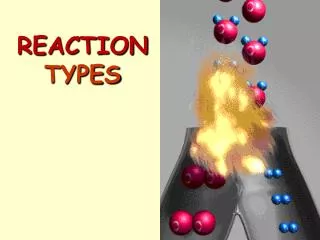
Combustion is a reaction involving oxygen, where heat is released Example: 2CH4 + 4O2 CO2 + 4H2O
Combustion products depend on the amount of oxygen present • If not enough oxygen is present, a combustion reaction may produce the toxic carbon monoxide as a product • Example: 2CH4 + 3O2 CO + 4H2O
Your favorite! • It’s good to hear it again though…