Daily Changes in Tides
This article explores the fascinating dynamics of ocean tides, caused by the gravitational pull of the Sun and Moon. Tides experience daily changes, with high and low tides occurring approximately every 12 hours, resulting in 6-hour intervals. Additionally, the article delves into monthly tidal changes, distinguishing between spring tides, which have a maximum tidal range after new or full moons, and neap tides with minimum range occurring after the first or third quarter moons. Illustrated examples from Anchorage, Alaska, and the Bay of Fundy in Canada provide deeper insights.

Daily Changes in Tides
E N D
Presentation Transcript
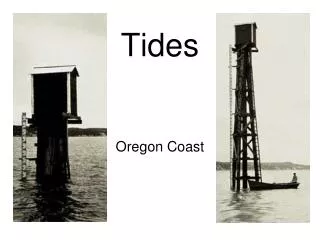
Tides- • Caused by gravity from the Sun and the Moon pulling on and deforming large bodies of water Historical Tide Gauge at Anchorage, Alaska
High Tide vs. Low Tide Daily Changes in Tides • High tides occur on the side of Earth closest to the Moon and the side opposite the Moon. • High tides on either side of the Earth will draw water away from the areas in between, causing low tides to form there. Low tide near a dock
For most places on Earth, high tides occur every 12 hours (twice a day). • For most places on Earth, low tides also occur every 12 hours (twice a day). • Therefore, there are generally 6 hours between high and low tides.
Monthly Tidal Changes Spring Tides • Tides with maximum daily tidal range (the difference in height between high water and low water.) • Occur right after the new or full moon, about every 14 days. • When the Sun, the Earth and the Moon are in alignment, and their gravities are working together to deform oceans.
Monthly Tidal Changes Neap Tides • Tides with minimum daily tidal range • Occur right after the 1st or 3rd quarter moon, about every 14 days • Occur when the gravitational forces of the sun and the moon work against each other • Occur halfway between spring tides
Spring Tides: High Tide at noon and midnight Neap Tides: High Tide at sunrise and sunset http://earthsci.terc.edu/content/investigations/es2406/es2406page03.cfm?chapter_no=investigation
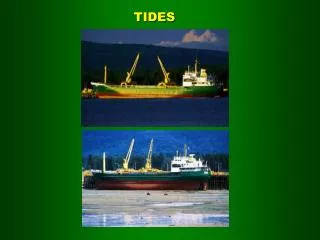
The Bay of Fundy Nova Scotia, Canada Upper picture = High tide Lower picture = Low tide (just 6 hours later)
High Tide vs. Low Tide