Understanding the Human Skeletal and Integumentary Systems
The human skeletal system provides shape, support, and movement while protecting vital organs and storing minerals. It consists of 206 bones, ligaments, tendons, and cartilage, with distinct types of bones including compact and spongy. The integumentary system consists of hair, skin, and nails, serving as a barrier against pathogens, regulating temperature, and facilitating communication of sensory information. Together, these systems play crucial roles in maintaining overall body function and health.

Understanding the Human Skeletal and Integumentary Systems
E N D
Presentation Transcript
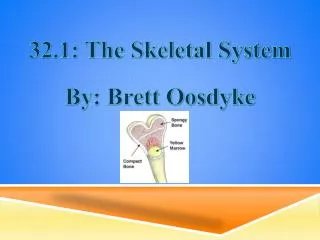
32.1: The Skeletal System By: Brett Oosdyke
The Skeletal System Function: • Provides shape and support • Allows movement • Protects tissues and organs • Stores certain minerals • Produces blood cells
The Skeletal System • Bones- A solid network of living cells and protein fibers that are surrounded by deposits of calcium. Structures of a bone: • Periosteum- The tough layer outer layer of the bone. • Compact Bone- contains Haversian canals that contain blood vessels and nerves • Spongy Bone- found in the ends of bones and produces RBC. • Yellow bone Marrow- made of fat cells. • Red Marrow- Produces RBC, WBC, and platelets.
The Skeletal System • Cartilage- Strong, connective tissue that supports the body. Softer and more flexible than bone • *There are approximately 206 bones in the human body.*
The Skeletal System • Cartilage is gradually replaced by bone during a process called ossification. • Osteoblasts secrete mineral deposits that replace cartilage in developing bones. • Osteocytes help maintain the minerals in bone tissue and continue to strengthen the growing bone.
TheSkeletalSystem • Ligaments- Hold bone to bone. Example: Hold bones together in knee; ACL. • Tendons- Hold muscle to the bones. Example: Achilles tendon attaches to the calf.
The Skeletal System • Joint- is any place where two bones come together. -Types of Joints: • Movable- prevent movement in one or more directions. Examples: pivot joint (radius and ulna); ball and socket (arm into shoulder) • Semi-movable- allow a little bit of restricted movement. Example: Vertebrae. • Immovable- allow no movement at all. Example: Skull
The Skeletal System Skeletal Disorders: Arthritis: Inflammation of joints Osteoporosis: loss of calcium in bones leading to weakening of bones
32.3 The Integumentary System: Hair, Skin, and Nails • Function: • Communication of pain, pressure, temperature • Protection of body: • Prevents dehydration • Regulates body temperature • Barrier for disease/infection • Covers and holds in organs • Removes waste products • Barrier for sun’s UV rays
The Integumentary System • Epidermis: Outermost layer -Two layers: -Inner layer: living cells -Outer layer: dead cells -Contains: -Keratin- waterproofing -Melanocytes- produces pigment
The Integumentary System • Dermis: middle layer • Contains: • -Hair follicles/roots • -Sweat glands • -Sebaceous (oil) glands • -Arrectorpili muscle • -Nerves • -Blood Vessels
The Integumentary System • Hypodermis (Subcutaneous Layer): Innermost layer • Contains: • Adipose (fat) cells: cushion, • insulation, anchors skin. • Blood vessels: temp. regulation, • nutrients, etc. • Nerves: temp., pressure, pain
The Integumentary System • Hair- made of dead epidermal cells. • Function: protect skin from UV rays (on head); provide insulation from cold; hairs in nose, ears, eyelashes prevent dirt and other particles from entering body. • Nails- Sheets of keratinized cells • Function: protects tips of fingers/toes