Guidelines for After School Snack Program Participation and Requirements
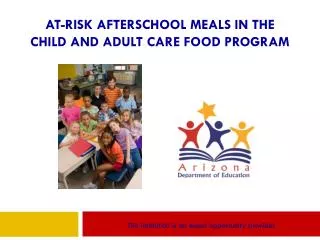
This document outlines the criteria for Local Education Agencies (LEAs) to participate in the After School Snack Program. LEAs must engage in the National School Lunch Program (NSLP) and provide educational and enrichment activities in a structured environment. Included are lists of programs that do not qualify for snacks, approved service locations, health and safety requirements, and eligibility criteria. The importance of adequate nutrition for child development and community benefits is emphasized, as well as the record-keeping and reimbursement process for participating LEAs.

Guidelines for After School Snack Program Participation and Requirements
E N D
Presentation Transcript
Criteria to Participate in anAfter School Snack Program • LEA must participate in the NSLP; and • The LEA must sponsor or operate a program which: • contains an educational/enrichment activity offered after the regular school day. • provides children with regularly scheduled activities in an organized, structured and supervised environment.
Criteria to Participate,continued It is the LEA that must assume/maintain responsibility for meeting Program requirements.
Programs not qualifying for an After School Snack Program • Organized athletic programs engaged in interscholastic or community level competition may not be approved: • Youth sport leagues, such as baseball leagues, soccer leagues, football leagues, and area swim teams would not qualify. • However, a supervised athletic activity may participate provided that they are open to all and do not limit membership.
Programs not qualifying,continued • Head Start Programs • ECEAP • Kindergarten Classes These programs would not be considered to be “after” the regular school day.
Approved Service Locations • Snack sites do not necessarily have to be located at a school • Boys and Girls Club • Churches • YMCA/YWCA • Community Learning Center
Health & Safety Requirements • LEAs should check with the local health department to see if there are any food safety requirements which must be met prior to serving snacks at a location other than a school.
Approved Service Days • After School Snack Programs must be regularly scheduled, following the regular school day (could be a program which meets weekly, or three times a week; does not have to be daily). • Snacks cannot be claimed for reimbursement that are served on weekends, holidays, school breaks, or during summer vacation.
Snack – Meal Pattern • Snacks must contain at least two of the four meal components (in the required amounts) • milk 8 fluid ounces • fruit and/or vegetable ¾ cup or 6 ounces • meat/meat alternate 1 ounce • bread/grain 1 serving
Eligibility Criteria • Snacks: • Snack sites must be added to the site application on the CNP web-based program. • Regular Snack Program: site is < 50% FRP. • Area Eligible Snack Program: site is ≥50%. • October Building Data. • It is possible to serve snacks free of charge to students at sites < 50% by billing a grant.
Area Eligibility – Defined • A site qualifies as area eligible if it is in the attendance area of a school which has at least 50% of it’s enrollment eligible for free or reduced-price meals. • A school that qualifies as “area eligible” may also qualify any other school/site in the same attendance zone.
Area Eligibility,continued An Elementary, middle, or a high school may be used to qualify any other school in the same attendance zone.
Record Keeping Requirements • The sponsor must maintain a snack production record to show meal pattern. • A roster or sign-in sheet of participating children must be maintained. • A point of service meal count must be maintained to show the number of snacks served. • Two on-site reviews are required; one during the first four weeks of the program, and one prior to the end of the school year/snack program.
Reimbursement • Area Eligible: All eligible snacks are reimbursed at the free rate $0.71 • Regular: Snacks are reimbursed according to student eligibility free $0.71 reduced-price $0.35 paid $0.06
Program Sense You may receive reimbursement for providing a snack to children who are attending an afterschool program. Research has shown a correlation between adequate nutrition and a child’s development and school performance.
Community Sense The community as a whole benefits from afterschool programs. • Child have a safe place to go after school. • Child are in a supervised setting. • Children are helped with homework and skills. • Child receive a snack, which helps hold them over until dinner.
Contact Information Please contact your assigned program specialist: Olympia Angela Ruiz 360-725-6212 Tacoma Linsey LaPlant 253-589-7252 Edmonds Kari Lund 425-776-2955 Yakima Pam Mahre 509-575-2412 Spokane Debra Calhoun 509-323-2751