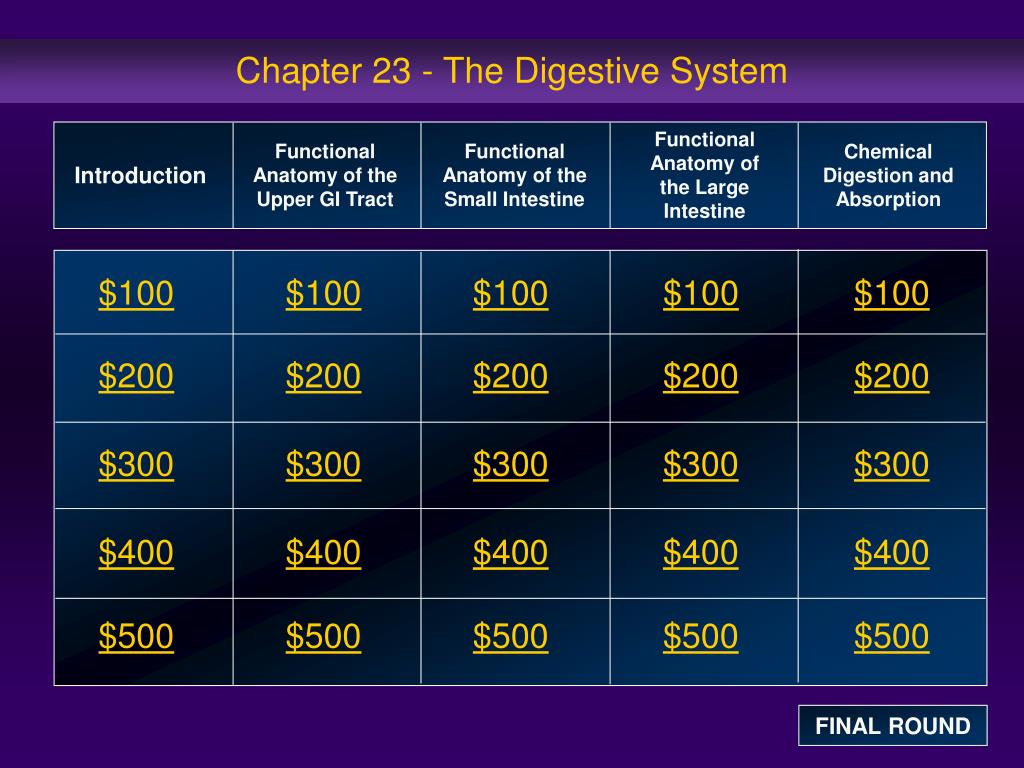
Chapter 23 - The Digestive System. Functional Anatomy of the Large Intestine. Functional Anatomy of the Upper GI Tract. Functional Anatomy of the Small Intestine. Chemical Digestion and Absorption. Introduction. $100. $100. $100. $ 100. $100. $200. $200. $200. $200. $200. $300.
Une image / un lien ci-dessous est fourni (tel quel) pour télécharger la présentation
Politique de téléchargement : le contenu du site vous est fourni TEL QUEL pour votre information et votre usage personnel ; il ne peut être vendu, concédé sous licence ni partagé sur d’autres sites sans l’accord de son auteur.Le contenu vous est fourni TEL QUEL, pour votre information et votre usage personnel uniquement.Téléchargez la présentation en cliquant sur ce lien.Lors du téléchargement, si vous ne parvenez pas à télécharger une présentation, l’éditeur a peut-être supprimé le fichier de son serveur.Pendant le téléchargement, si vous ne parvenez pas à obtenir une présentation, le fichier a peut-être été supprimé par l’éditeur.
F I N
Plus de contenu associé
Transcription de la présentation
Chapter 23 - The Digestive System Functional Anatomy of the Large Intestine Functional Anatomy of the Upper GI Tract Functional Anatomy of the Small Intestine Chemical Digestion and Absorption Introduction $100 $100 $100 $100 $100 $200 $200 $200 $200 $200 $300 $300 $300 $300 $300 $400 $400 $400 $400 $400 $500 $500 $500 $500 $500 FINAL ROUND
Introduction:$100 Question • Peristalsis is part of which digestive process? • a. Absorption • b. Ingestion • c. Propulsion • d. Chemical digestion ANSWER BACK TO GAME
Introduction:$100 Answer • Peristalsis is part of which digestive process? • a. Absorption • b. Ingestion • c. Propulsion • d. Chemical digestion BACK TO GAME
Introduction:$200 Question • All of the following are part of the alimentary canal except the: • a. pharynx. • b. esophagus. • c. small intestine. • d. liver. ANSWER BACK TO GAME
Introduction:$200 Answer • All of the following are part of the alimentary canal except the: • a. pharynx. • b. esophagus. • c. small intestine. • d. liver. BACK TO GAME
Introduction:$300 Question • Simple columnar epithelium is found in which histological layer of the alimentary canal? • a. Submucosa • b. Muscularis • c. Serosa • d. Mucosa ANSWER BACK TO GAME
Introduction:$300 Answer • Simple columnar epithelium is found in which histological layer of the alimentary canal? • a. Submucosa • b. Muscularis • c. Serosa • d. Mucosa BACK TO GAME
Introduction:$400 Question • Which histological layer of the alimentary canal is also known as the visceral peritoneum? • a. Submucosa • b. Muscularis • c. Serosa • d. Mucosa ANSWER BACK TO GAME
Introduction:$400 Answer • Which histological layer of the alimentary canal is also known as the visceral peritoneum? • a. Submucosa • b. Muscularis • c. Serosa • d. Mucosa BACK TO GAME
Introduction:$500 Question • The membrane that lines the body wall of the abdominal cavity is the: • a. ventral mesentery. • b. visceral peritoneum. • c. parietal peritoneum. • d. retroperitoneum. ANSWER BACK TO GAME
Introduction:$500 Answer • The membrane that lines the body wall of the abdominal cavity is the: • a. ventral mesentery. • b. visceral peritoneum. • c. parietal peritoneum. • d. retroperitoneum. BACK TO GAME
Functional Anatomy of the Upper GI Tract:$400 Question • Which of the following phases of gastric secretion is a conditioned reflex? • a. Gastric phase • b. Cephalic phase • c. Intestinal phase • d. All three phases above are conditioned reflexes. ANSWER BACK TO GAME
Functional Anatomy of the Upper GI Tract:$400 Answer • Which of the following phases of gastric secretion is a conditioned reflex? • a. Gastric phase • b. Cephalic phase • c. Intestinal phase • d. All three phases above are conditioned reflexes. BACK TO GAME
Functional Anatomy of the Upper GI Tract:$500 Question • The gastric cells that secrete pepsinogen are the: • a. mucous neck cells. • b. parietal cells. • c. chief cells. • d. enteroendocrine cells. ANSWER BACK TO GAME
Functional Anatomy of the Upper GI Tract:$500 Answer • The gastric cells that secrete pepsinogen are the: • a. mucous neck cells. • b. parietal cells. • c. chief cells. • d. enteroendocrine cells. BACK TO GAME
Functional Anatomy of the Small Intestine:$100 Question • Most of the digestive enzymes found in the small intestine are secreted by this accessory organ. • a. Liver • b. Gallbladder • c. Stomach • d. Pancreas ANSWER BACK TO GAME
Functional Anatomy of the Small Intestine:$100 Answer • Most of the digestive enzymes found in the small intestine are secreted by this accessory organ. • a. Liver • b. Gallbladder • c. Stomach • d. Pancreas BACK TO GAME
Functional Anatomy of the Large Intestine:$300 Question • The functions of the large intestine include all of the following except: • a. elimination of waste. • b. absorption of water and electrolytes. • c. absorption of nutrients. • d. production of vitamins. ANSWER BACK TO GAME
Functional Anatomy of the Large Intestine:$300 Answer • The functions of the large intestine include all of the following except: • a. elimination of waste. • b. absorption of water and electrolytes. • c. absorption of nutrients. • d. production of vitamins. BACK TO GAME
Functional Anatomy of the Large Intestine:$400 Question • Which of the following reflexes are we able to voluntarily control? • a. Gastroileal reflex • b. Gastrocolic reflex • c. Enterogastric reflex • d. Defecation reflex ANSWER BACK TO GAME
Functional Anatomy of the Large Intestine:$400 Answer • Which of the following reflexes are we able to voluntarily control? • a. Gastroileal reflex • b. Gastrocolic reflex • c. Enterogastric reflex • d. Defecation reflex BACK TO GAME
Functional Anatomy of the Large Intestine:$500 Question • Mass movement in the large intestine is initiated by the: • a. gastroileal reflex. • b. gastrocolic reflex. • c. enterogastric reflex. • d. defecation reflex. ANSWER BACK TO GAME
Functional Anatomy of the Large Intestine:$500 Answer • Mass movement in the large intestine is initiated by the: • a. gastroileal reflex. • b. gastrocolic reflex. • c. enterogastric reflex. • d. defecation reflex. BACK TO GAME
Chemical Digestion and Absorption:$200 Question • Which of the following enzymes is not found in adults? • a. Carboxypolypeptidase • b. Lipase • c. Rennin • d. Chymotrypsin ANSWER BACK TO GAME
Chemical Digestion and Absorption:$200 Answer • Which of the following enzymes is not found in adults? • a. Carboxypolypeptidase • b. Lipase • c. Rennin • d. Chymotrypsin BACK TO GAME
Chemical Digestion and Absorption:$500 Question • Micelles are formed during the absorption of which nutrient? • a. Monosaccharides • b. Fatty acids • c. Amino acids • d. Disaccharides ANSWER BACK TO GAME
Connexion au compte
Connectez-vous pour publier votre contenu sur SlideServe.