SlideServe
Menu
Préférences
© SlideServe · v2026

The Original 13 Colonies

issac avatar
23 diapositives · 690 Views · Dec 16, 2011

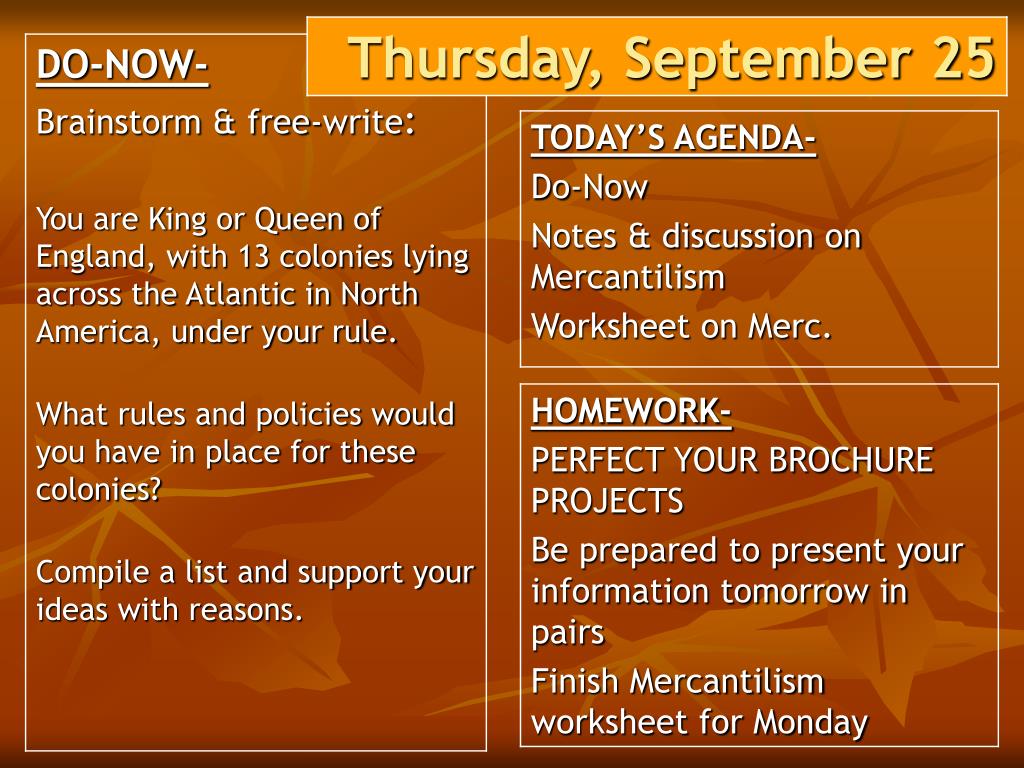
The Original 13 Colonies. Reasons why England valued its North American colonies. 1. The colonies supplied food and raw materials - $$$ 2. The colonies purchased large amounts of finished English goods - $$$. Reasons why England’s North American colonies could be problematic.
The Original 13 Colonies - slide 1
01 / 23The Original 13 Colonies
1 / 17

Télécharger la présentation

The Original 13 Colonies
Une image / un lien ci-dessous est fourni (tel quel) pour télécharger la présentation

Politique de téléchargement : le contenu du site vous est fourni TEL QUEL pour votre information et votre usage personnel ; il ne peut être vendu, concédé sous licence ni partagé sur d’autres sites sans l’accord de son auteur.Le contenu vous est fourni TEL QUEL, pour votre information et votre usage personnel uniquement. Téléchargez la présentation en cliquant sur ce lien. Lors du téléchargement, si vous ne parvenez pas à télécharger une présentation, l’éditeur a peut-être supprimé le fichier de son serveur.Pendant le téléchargement, si vous ne parvenez pas à obtenir une présentation, le fichier a peut-être été supprimé par l’éditeur.

F I N

Plus de contenu associé

Transcription de la présentation

  1. The Original 13 Colonies

  2. Reasons why England valued its North American colonies 1. The colonies supplied food and raw materials - $$$ 2. The colonies purchased large amounts of finished English goods - $$$

  3. Reasons why England’s North American colonies could be problematic 1. Widespread, difficult to establish government 2. A great distance from England itself, also making government a challenge

  4. Besides distance, what other reason did England have for neglecting its North American Colonies?

  5. English Civil War • Civil War from 1640-1660 • Fought between King Charles I and Parliament • King limited the powers of Parliament by demanding taxes of the people • King is beheaded! (by Parliament’s orders) • Oliver Cromwell takes over, unrest ensues • Finally King Charles II takes the throne in 1660, restored stability

  6. Economics • War debts emphasized the need for the colonies to contribute to England’s overall economic health. • The theory of Mercantilism was starting to become popular among the nations of Western Europe.

  7. So, what is this “Mercantilism”?

  8. Mercantilism • A theory that a country should try to collect as much bullion (gold and silver) as possible, creating wealth and power. • If a country sold more goods to other countries than it bought from them, it would acquire this bullion. • Put Simply: To become rich, exports should exceed imports

  9. But how do the colonies fit in to Mercantilism?

  10. England’s relationship with the colonies: • Believed the Colonies existed to benefit the “Mother Country” England • England had started the Colonies and had the right to benefit from them And, Coming Soon… • England would provide armies and ships during the French and Indian War to the Colonies. • England developed a large debt during the French and Indian War to defend the Colonies.

  11. Specific Purposes of the Colonies • To establish British Naval Power • building ships • providing England with ship-related supplies • providing sailors • Keep money in the empire!! • Providing raw materials • Providing other goods England could not produce • Tobacco • Sugar • Etc.

  12. Mercantilism • England at first paid little attention to the colonies (civil war) • Then Charles II came to power, • Things changed! • England began exercising power over the colonies • First by punishing a defiant Massachusetts

  13. Mercantilism • England at first paid little attention to the colonies (civil war) • Then Charles II came to power, • Things changed! • England began exercising power over the colonies • First by punishing a defiant Massachusetts

  14. Mercantilism • In 1662, the England legalized CT, and in 1636, recognized RI • Both of which took land from Mass. • Charles II then began to enforce and Issue the Navigation Acts!

  15. Navigation Acts1651, 1660, 1663, and 1673 • Reinforced Mercantilism • Colonies exports go only to England and her other Colonies • Imports from elsewhere must go through England • extra tax will be added  • All goods (imports, exports) for the Colonies must be delivered by English ships.

  16. Navigation Acts1651, 1660, 1663, and 1673 England restricted the colonies from producing any goods also made in England! • England decided could be produced in the colonies. • Colonies are to complement England, NOT compete with England!!

  17. Did the policy of Mercantilism Help or Hurtthe American colonies?

  18. It hurt the colonies!! • The British could only buy so many goods • This drained the American economy. • The colonists had no money to buy what they needed if they could not sell their own products. • All would have to go into debt to obtain these goods 

  19. Apply your knowledge • Complete the worksheet “Great Britain Controls Colonial Trade”

  20. Stamp Act:  Placed tax on newspapers and other legal documents. • Sugar Act:  Lowered taxes on products leaving the Colonies but raised taxes on imported goods. • Currency Act:  England has the right to set currency only. • Townshend Act:  Place taxes on colonial imports of everyday goods. • Declaratory Act:  England has right to tax and rule over the Colonies