Download
1 / 6
60 likes | 206 Vues
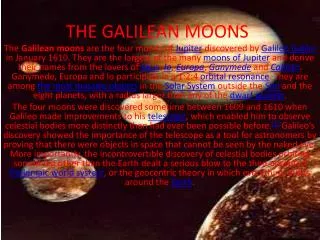
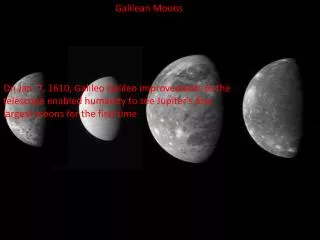
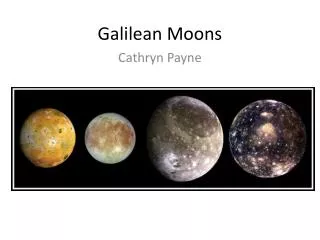
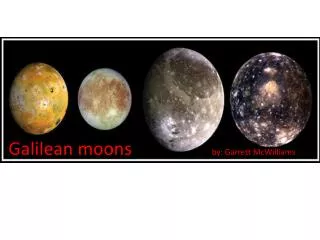
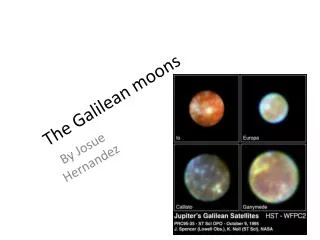
This overview details the three of the Galilean moons of Jupiter: Io, Europa, and Ganymede. Io is noted for its volcanic activity, with a diameter of 3,660 km and an unusual density of 3.528 g/cm³. Europa, the second closest moon, is recognized for its potential subsurface ocean, having a diameter of 3,121.6 km and a density of 3.014 g/cm³. Ganymede, the largest moon in the solar system, presents intriguing characteristics ripe for exploration. These moons highlight the diversity and complexity of celestial bodies in the Jovian system.

E N D
The Galilean moons By Josue Hernandez
Lo • Is one of the four moons of the Galileo. The diameter is 3660.0*3637.4*3630.6. the mass is 8.93*1022. the density is 3.528. the semi major axis is 421,800. the orbital period is 1.769. the inclination is 0.050. the eccentricity is 0.0041.
Europa • Is the second closet moon to Jupiter and is one of the moons. The diameter is 3121.6. the mass is 4.8×10²². The density is 3.014. the semi major axis is 671,100. the orbital period is 3.551. the inclination is 0.471. the eccentricity is 0.0094.