Discovering the Galilean Moons: Insights into Jupiter's Mysterious Satellites
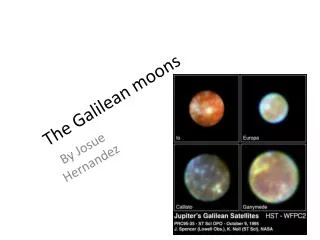
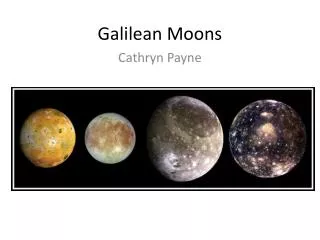
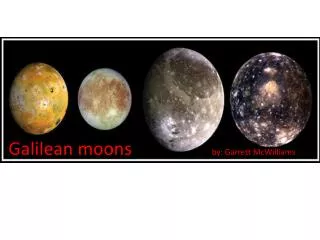
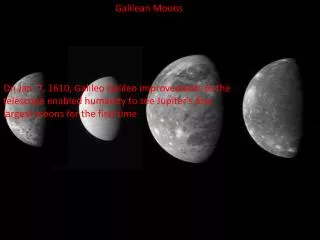
On January 7, 1610, Galileo Galilei revolutionized astronomy with his telescope, unveiling Jupiter's four largest moons: Io, Europa, Ganymede, and Callisto. Of these, Europa stands out with its smooth, icy surface, which likely conceals a vast ocean of liquid water beneath. Recent data from the New Horizons mission has provided insights into Europa's surface composition and subtle features, offering exciting possibilities for understanding its ocean and icy shell. These discoveries may hold clues to the potential for life beyond Earth.

Discovering the Galilean Moons: Insights into Jupiter's Mysterious Satellites
E N D
Presentation Transcript
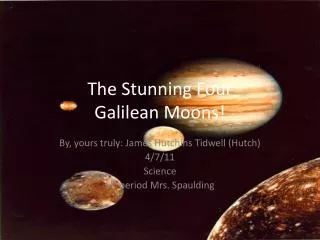
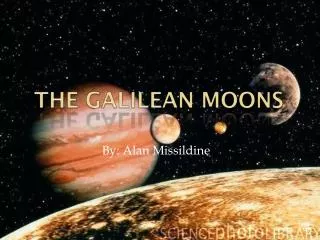
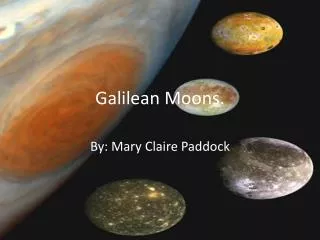
Galilean Moons Galilean Moons • On Jan. 7, 1610, Galileo Galilei's improvements to the telescope enabled humanity to see Jupiter's four largest On Jan. 7, 1610, Galileo Galilei's improvements to the telescope enabled humanity to see Jupiter's four largest moons for the first time.first time. On Jan. 7, 1610, Galileo Galileo improvements to the telescope enabled humanity to see Jupiter's four largest moons for the first time.
Europa Europa • Europa's smooth, icy surface likely conceals an ocean of liquid water. New Horizons obtained data on Europa's surface composition and imaged subtle surface features, and analysis of these data may provide new information about the ocean and the icy shell that covers it. • Europa's smooth, icy surface likely conceals an ocean of liquid water. New Horizons obtained data on Europa's surface composition and imaged subtle surface features, and analysis of these data may provide new information about the ocean and the icy shell that covers it.
http://www.nasa.gov/multimedia/imagegallery/image_feature_1560.htmlhttp://www.nasa.gov/multimedia/imagegallery/image_feature_1560.html