
Comprehensive Review of Thermodynamics Concepts and Calculations
This review game covers essential topics in thermodynamics, including the heat of fusion, Gibbs energy, entropy, molar heat capacity, and enthalpy. Questions explore the calculations involved in determining heat absorbed or released during chemical reactions, the spontaneous nature of reactions, and the relationships between different thermodynamic variables. Players will engage with various scenarios and equations to deepen their understanding of energy changes in physical and chemical processes. Perfect for students preparing for exams in physical chemistry.
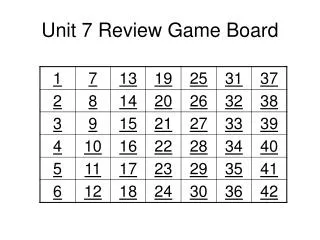

Comprehensive Review of Thermodynamics Concepts and Calculations
E N D
Presentation Transcript
1 What is the heat of fusion in kJ/g of a substance if it takes 65980 J of heat to melt a 55 g sample of the substance? 1.2 kJ/g Back
2 A reaction occurs spontaneously when G is: negative Back
3 605 K equals how many degrees Celsius? 332 C Back
4 A measure of the average kinetic energy of the particles in a sample of matter? Temperature Back
5 What letter corresponds to the melting of a solid? b Back
6 In the equation, q = nCT, what does q stand for? heat Back
7 What is a measure of the disorder in a system? entropy Back
8 What is the formula that defines the change in Gibbs energy? G = H – TS Back
9 The study of all energy changes is called Thermodynamics Back
10 In the equation, q=nCT, what does C stand for? Molar heat capacity Back
11 According to ____________________, the overall enthalpy change in a reaction is equal to the sum of the enthalpy changes of individual steps. Hess’s Law Back
12 A positive S means the process was ____________. More disorderly Back
13 Entropy plays a larger role in determining the Gibbs energy of reactions that take place at _____________ temperatures. Higher Back
14 This is the energy of a system at constant pressure. Enthalpy Back
15 In the Gibb’s energy equation, ___________ is the symbol for entropy. S Back
16 The standard enthalpy of formation of a(n) ____________ is equal to zero. element Back
17 In the expression q = nCT, what does n represent? moles Back
18 A negative G means the process was ____________. spontaneous Back
19 The term ____________________ refers to the amount of energy as heat required to raise the temperature of 1 mole of a substance by 1 K. Molar heat capacity Back
20 A negative H means the process was ____________. exothermic Back
21 A device used to measure the heat absorbed or released in a chemical or physical change calorimeter Back
22 This equation is used to calculate heat. q=nCT Back
23 What letter represents the range where the liquid is being warmed? c Back
24 In the Gibb’s energy equation, __________ is the symbol for enthalpy. H Back
25 What is 52 Joules in calories? 12.4 calories Back
26 A 58.2 g sample was heated from 300 K to 350 K. It absorbed 1523 J of energy. What is the specific heat of iron? 0.53 J/gK Back
27 The total entropy of the products in a reaction is 732 J/K, and the total entropy of the reactants is 524 J/K. What is S for the reaction? 208 J/K Back
28 452 ºF to ºC 233 C Back
29 How much energy as heat does an iron (MM = 55.8 g/mol) sample gain if its molar heat capacity is 25.1 J/K mol, its mass is 33.01 g, and it is heated from 15.0°C to 42.0°C? 400.9 J Back
30 If 1484 J of energy as heat is released from a 800 g block of aluminum (MM = 27.0). What temperature change occurred if the molar heat capacity of aluminum is 24.2 J/K.mol? 2.07 K Back
31 What is the boiling point of the substance (number)? 450 K Back
32 A 426.3 g sample of Gold (MW = 197) was heated from 0°C to 20°C. It absorbed 1108 J of energy. What is the molar heat capacity of iron? 25.6 J/mol.°C Back
33 341 K equals how many degrees Fahrenheit? 154 C Back
34 What is the value of G at 330 K for a reaction in which H = –103 kJ/mol and S = +23.00 J/mol K? -110590 J/mol Or -110.59 kJ/mol Back
35 For a process in which H is –98 kJ and S is 132 J/K, calculate the change in the free energy at 0°C. -134036 J/mol Or -134 kJ/mol Back
36 When calculating the change in enthalpy of a reaction, this is the equation that is used. H reaction = H products - H reactants Back
37 Water has a specific heat of 4.18 J/gK. What is its molar heat capacity? 75.24 J/molK Back
38 How much heat would be needed to evaporate 100 g of water if the heat of vaporization of water is 2.26 kJ/g? 226 kJ Back
39 How much energy as heat does a 9 mol titanium sample gain if its molar heat capacity is 27.8 J/K mol and it is heated from 15°C to 55.0°C? 10008 J Back
40 What is the standard thermodynamic temperature? 25 C (or 298 K) Back
41 The English measurement for measuring energy is the ___________ calorie Back
42 What is the melting point of this substance? 300 K A B Back