
Exploring Earth's Mysteries: Volcanoes, Drills, Gravity & Magnetic Fields
E N D
Presentation Transcript
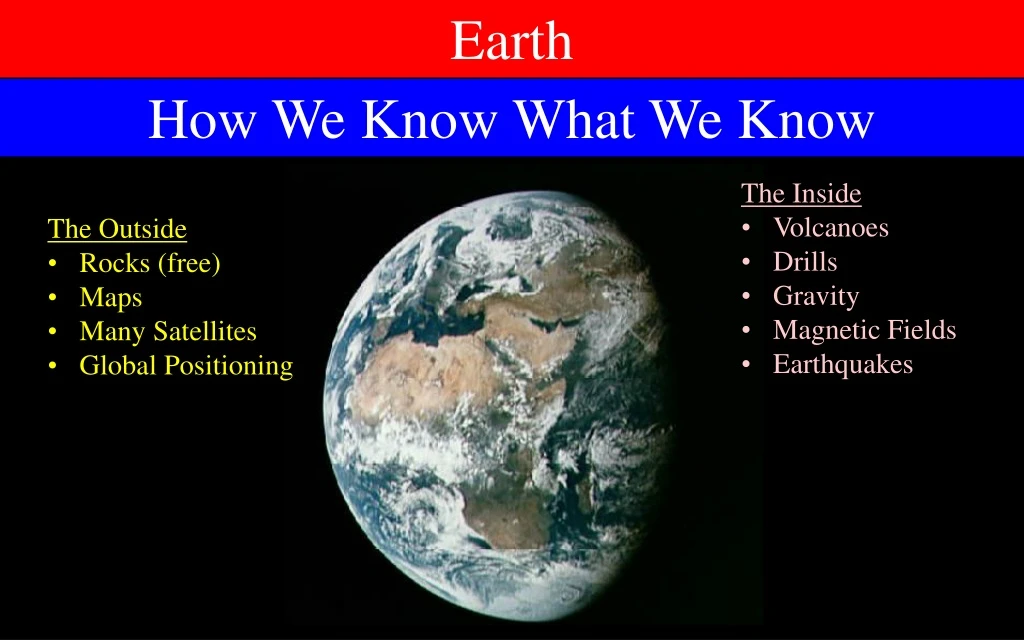
Earth How We Know What We Know The Inside • Volcanoes • Drills • Gravity • Magnetic Fields • Earthquakes The Outside • Rocks (free) • Maps • Many Satellites • Global Positioning
Some Earth Satellites ISS Aura ADEOS-2 Terra ICESat-2 GOES 13 Earth Observing Mission 2
Continental Plates – Global Positioning • Surface is moving • A few cm per year
The Earth – Deep Drilling • Greatest depth drilled = 12 km
The Earth – Volcanoes • Provide samples from shallow interior of Earth
The Earth – Clues to the Interior • Gravity measures mass of Earth • Magnetic fields from interior • Fluid Layer • Conductor (metal) • Motion (rotation) • Earthquakes!
Earthquakes San Andreas Fault
Earthquakes • Different types of waves travel differently through the Earth • P-waves are pressure waves • Can travel through solids and liquids • S-waves are shear waves • Can travel through solids only • Surface waves travel only on the surface
Earth’s Interior • The Crust • Thin layer of lightweight rocks • Rigid – can’t flow • The Mantle – largest part • Denser rocks • Plastic – can be deformed slowly • Flows over time • Cores • Mostly iron • Outer core – liquid • Inner core – solid Q. 29: Earth’s Magnetic Field
Convection • Heat inside Earth causes expansion • Lower density causes hot areas to rise • Like water in a pan • Plastic mantle can flow as well • Continents carried on topof flowing mantle • Rigid crust can’t flow - it breaksinstead (sometimes)
Earth’s Magnetic Field • Outer core is liquid metal • Currents can flow in it • Rotation of Earth regenerates field • Tilted compared to rotation axis • Direction/strength changes over time • Charged particles from Sun deflected by our magnetic field • Solar wind on atmosphere creates Aurora Borealis and Australis
Factors Causing Earth’s Surface Features • Moving plates • Mountains • Ocean Trenches • Continents • Subduction • Erosion • Rain • Wind • Volcanoes
Earth – Meteor Craters Q. 30: Earth’s Meteor Craters • Atmosphere blocks or slows all but the largest meteors • Only large meteors make it through • Erosion wipes out evidence of most of these • All but the largest get eliminated over time • In the long run, volcanism and subduction eliminate the rest • The oldest craters are all gone
The Earth: Atmosphere • Composition • Nitrogen • Oxygen • Moderates temperatures • Globally • Temporally
The Earth: Water • Earth is only place in Solar System with liquid water on the surface • Allows life to develop?
The Earth: Greenhouse Effect • Visible sunlight heats the surfaceof the Earth • Some reflected by clouds • Some reflected by Earth • Warm Earth reradiates infraredradiation • Penetrates most of atmosphere fine • Some is captured again • Since Earth is more efficient at transmitting visible than infrared, Earth is warmer than you would expect • The greenhouse effect
Greenhouse Gasses • Some gasses are better at transmitting visible than infrared • Water vapor (H2O) – Not very efficient, but there’s a lot of it • Carbon dioxide (CO2) – Very efficient, reasonably abundant • Methane (CH4) – Extremely efficient, but very little of it • Most energy production produces carbon dioxide • Coal – produces the most • Oil – produces a lot • Natural gas – produces some • Nuclear, Solar, wind, Geothermal, etc. – produces none
Life on Earth • Earth contains oxygen because of plants • Plants also absorb carbon dioxide • Killing plants warms the Earth Q. 31: Life on Other Planets