Explore Project Jag: A Rube Goldberg Device for Lighting Bulbs
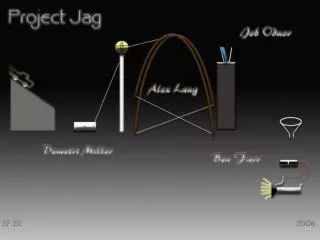
Project Jag is a creative Rube Goldberg device that showcases the principles of physics by using gravity to light a bulb. The device features a rolling jaguar that sets off a sequence of events: a tennis ball swings to knock over a box, releasing a battery that falls into a funnel and strikes a metal box, completing the circuit to turn on the light bulb. Although we neglected friction and air resistance in our calculations, the project effectively illustrates energy conversion, demonstrating how complex systems can achieve simple tasks through interconnected motions.

Explore Project Jag: A Rube Goldberg Device for Lighting Bulbs
E N D
Presentation Transcript
Device Overview • Project Jag is a Rube-Goldberg device which utilizes gravity to perform the task of turning on a light bulb.
Energy Conversions Overview • The jaguar (not mini cooper) rolls down the incline • The elevated tennis ball swings to knock over the box • The battery falls through a funnel and hits the metal box which turns on the light bulb
Assumptions • Friction neglected • Velocity of battery falling through funnel is zero at point right before stem • Air resistance neglected
Energy Equation 1 mgh=0.5mv^2 Masses cancel gh=0.5v^2 (32.2ft/s^2)(0.21ft)=0.5(v^2) v=3.7ft/s Energy Equation 2 mgh=0.5mv^2 Masses cancel gh=0.5v^2 (32.2ft/s^2)(0.5ft)=0.5(v^2) v=5.7ft/s Calculations
Calculations • Energy Equation 3 *Note, velocity will vary with height of table. Given formula is with height of test table. • mgh=0.5mv^2 • Masses cancel • gh=0.5v^2 • (32.2)(2.2ft)=0.5(v^2) • v=11.9ft/s
Problems • Making sure we had all supplies we needed • Figuring out a way to make the battery consistently fall into funnel • Finding an object small enough to fit through a funnel but heavy enough to flip a switch
Conclusion • Rube-Goldberg devices are complicated ways of doing simple tasks but good real life examples of physics at work • Jaguars and mouse traps don’t mix