Download

1 / 22
220 likes | 356 Vues
This paper presents innovative digital arithmetic circuits inspired by the Chinese abacus method, focusing on a new Chinese abacus adder implemented through Binary-to-Abacus (BA) and Thermometric-to-Binary (TB) modules. The Parallel Addition (PA) module allows simultaneous addition of abacus numbers. We provide detailed examples, results of performance comparisons with Conventional Adders, and discuss the extension of the adder to a 4n-bit format. This work emphasizes significant reductions in delay time and power consumption, showcasing the advantages of this novel design.

E N D
Zhongkai Chen The Novel Chinese Abacus Adder
Literature Information • Appears in: VLSI Design, Automation and Test, 2007. VLSI-DAT 2007. International Symposium on Date:25-27 April 2007 • Zi-Yi Zhao, Chien-Hung Lin, Yu-ZhiXie, Yen-Ju Chen, Yi-Jie Lin, and Shu-Chung Yi. • National Changhua University of Education, Changhua, Taiwan 500, ROC
Outline • Introduction • BA (Binary to Abacus) Module • PA (Parallel Addition) Module • TB (Thermometric to Binary) Module • Example • Extension to 4n-Bit Adder • Results
Introduction • The first digital arithmetic circuits employing the method of the Chinese abacus were proposed on 1998. • The most drawback is the delay time due to serial addition of each bead by the Shift-Up module
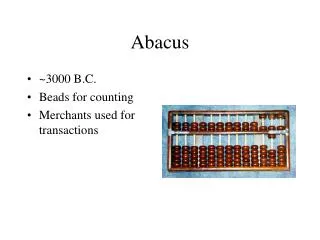
Introduction • (a) Chinese abacus coding with base 10 of the decimal number 6 • (b) the proposed Chinese abacus adder coding with base 16 of the decimal number 9 4 5 1 1
Introduction Block diagram of the 4-bit abacus adder
BA (Binary to Abacus) Module • This module converts a 4-bit binary number (I3I2I1I0)2 into an abacus representation (H2H1H0 | L2L1L0)abacus. • H2H1H0 and L2L1L0 are determined by: H2=I3I2, H1=I3, H0=I3+I2 L2=I1I0, L1=I1, L0=I1+I0 Where 0≤H2 ≤H1 ≤H0 ≤1, and 0 ≤L2 ≤L1 ≤L0 ≤1. H2H1H0: Higher Beads L2L1L0: Lower Beads
PA (Parallel Addition) Module • This block can parallel add two abacus numbers simultaneously. • The sum of (X2X1X0) and (Y2Y1Y0) will then be represented as the thermometric transformation (K5K4K3K1K0), where 0 ≤Ki ≤Kj ≤1 for i>j.
PA (Parallel Addition) Module • The behavior of PA module is modeled in the following equations: This module acts similarly as a multiplexer. The addend X2~X0 are as signal selectors to modify the configuration of augend Y2~Y0. The thermometric results will be then represented in K5~K0. There are only four configurations of addend (X2X1X0), i.e., (000), (001), (011), or (111).
TB (Thermometric to Binary) Module • This module transforms thermometric representation to binary numbers. The outputs O1, Oo and C0ut are determined by the following equations: • O0=K0∙Cin+K1∙K0∙Cin+K2∙K1∙Cin+K3∙K2∙Cin+K4∙K3∙Cin+K5∙K4∙Cin+K5∙Cin • O1=K5+K4 ∙Cin+K2 ∙K0 ∙Cin+K4 ∙K1 ∙Cin • Cout=K3+ K2 ∙Cin
Example: 9+13 • 9=>(1001) 13=> (1101) • (1001)+(1101) • BA Module: • BA1: (1001)2=(011|001)abacus • BA2: (1101)2=(111|001)abacus • PA Module: • PA1: X2=0 X1=1 X0=1 Y2=1 Y1=1 Y0=1 • PA2: X2=0 X1=0 X0=1 Y2=0 Y1=0 Y0=1
Example: 9+13 • PA1: X2=0 X1=1 X0=1 , Y2=1 Y1=1 Y0=1, f1=X2X1=1, f2=X1X0=0 K0=1, K1=1, K2=Y0=1, K3=Y1=1, K4=Y2=1 K5=0
Example: 9+13 • PA2: X2=0 X1=0 X0=1, Y2=0 Y1=0 Y0=1, f1=X2X1=0 f2=X1X0=1 K0=1 K1=Y0=1 K2=Y1=0 K3=Y2=0 K4=0 K5=0
Example: 9+13 • TB Module: • TB2: • Cin=0, K0=1 K1=1 K2=0 K3=0 K4=0 K5=0 • O0=…=0+0+0+0+0+0+0=0 • O1=…=0+0+0+1=1 • Cout=…=0 • O0=K0∙Cin+K1∙K0∙Cin+K2∙K1∙Cin+K3∙K2∙Cin+K4∙K3∙Cin+K5∙K4∙Cin+K5∙Cin • O1=K5+K4 ∙Cin+K2 ∙K0 ∙Cin+K4 ∙K1 ∙Cin • Cout=K3+ K2 ∙Cin
Example: 9+13 • TB1 • Cin=0, K0=1, K1=1, K2=1, K3=1, K4=1 K5=0 • O0=…=0+0+0+0+0+1+0=1 • O1=…=0+0+0+0=0 • Cout=…=1+0=1 • Final Answer: (10110)2 =22 • O0=K0∙Cin+K1∙K0∙Cin+K2∙K1∙Cin+K3∙K2∙Cin+K4∙K3∙Cin+K5∙K4∙Cin+K5∙Cin • O1=K5+K4 ∙Cin+K2 ∙K0 ∙Cin+K4 ∙K1 ∙Cin • Cout=K3+ K2 ∙Cin
Extension to 4n-Bit Adder • Generally, conventional fast adders of high bit number are all connected by 4-bit unit adders. The Chinese abacus adder can also extend to 4n-bit adder by CLA-like or conditional-sum-adder-like methods. The Cout of CLA: Ci+1=Gi+PiCi The Cout of Abacus Adder: Cout=K3+K2Cin Compared the above two equations, the 4-bit basic unit abacus adder can be extended to a 4n-bit CLA-like abacus adder Extend both A and B to 4 bits Replace it with Abacus Adder
Results • The delay of the 8-bit abacus adders are 22%, and 14% less than those of CLA adders for 0.35um, and 0.18um technologies, respectively. • The power consumption of the abacus adders are 30%, and 60% less than those of CLA adders for 0.35um, and 0.18um technologies, respectively. • The transistor count of abacus adder is similar to that of CLA
Results • The delays of the 32-bit abacus adder are 17%, and 12% less than those of CLA adder for 0.35um, and 0.18um technologies, respectively.
Thank you. Questions?