

SlideServe
Menu
Préférences
© SlideServe · v2026

Superconductivity

ivrit avatar
22 diapositives · 564 Views · Aug 07, 2014

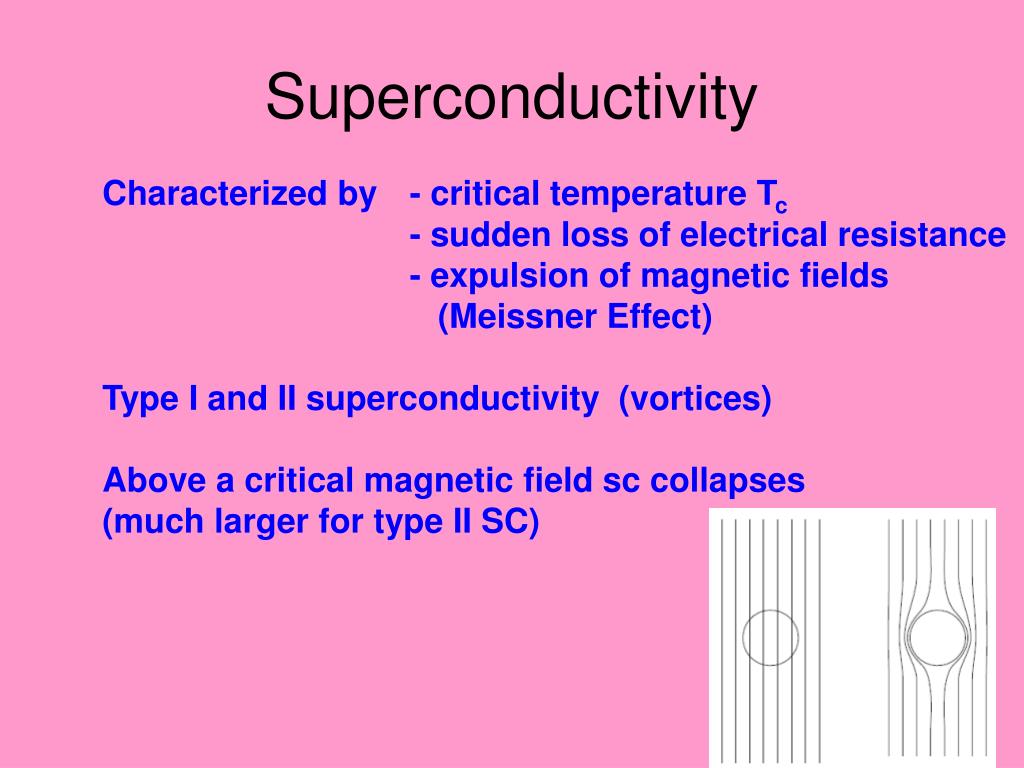
Superconductivity. Characterized by - critical temperature T c - sudden loss of electrical resistance - expulsion of magnetic fields (Meissner Effect) Type I and II superconductivity (vortices) Above a critical magnetic field sc collapses (much larger for type II SC).
Superconductivity - slide 1
01 / 22Superconductivity
1 / 17

Télécharger la présentation

Superconductivity
Une image / un lien ci-dessous est fourni (tel quel) pour télécharger la présentation

Politique de téléchargement : le contenu du site vous est fourni TEL QUEL pour votre information et votre usage personnel ; il ne peut être vendu, concédé sous licence ni partagé sur d’autres sites sans l’accord de son auteur.Le contenu vous est fourni TEL QUEL, pour votre information et votre usage personnel uniquement. Téléchargez la présentation en cliquant sur ce lien. Lors du téléchargement, si vous ne parvenez pas à télécharger une présentation, l’éditeur a peut-être supprimé le fichier de son serveur.Pendant le téléchargement, si vous ne parvenez pas à obtenir une présentation, le fichier a peut-être été supprimé par l’éditeur.

F I N

Plus de contenu associé

Transcription de la présentation
  1. Superconductivity Characterized by - critical temperature Tc - sudden loss of electrical resistance - expulsion of magnetic fields (Meissner Effect) Type I and II superconductivity (vortices) Above a critical magnetic field sc collapses (much larger for type II SC)

  2. Technological Importance • Lossless energy conduction • Miniaturization (downtown & in space) • Effective Transportation (MagLevs) • Strong Magnetic Fields (fusion, MRI) • Thin Film detector technology/nano-tech Basic Research Importance • Macroscopic Quantum Effect • A basic state of all matter?

  3. Theory of SC Until 1986 SC was considered the one completely solved problem of condensed matter physics. BCS theory (Bardeen, Cooper, Schrieffer) a QM many-body theory - predicted Tc and a theoretical limit for Tc - below Tc 2 cond. e- of opposite impulse and spin build ‘Cooper pair’ and correlate to a macroscopic liquid that needs to be excited collectively (and thus obey a different statistic – ‘Fermi Liquid’) - at Tc energy gap D, BCS value 3.52 kBTc = 2 D - mediation of process through e--phonon coupling

  4. Validation of BCS Theory • All known SC (elemental metals, alloys, compounds) • obeyed the law of max. Tc • NMR experiments measured and confirmed • the energy gap • Late 1980s: Exotic SC emerges • In rapid succession several classes of SC were • discovered which did not obey BCS theory. • Heavy Fermions - HTSC • Organic SC - ladder compounds • Today SC is perhaps the least understood phenomenon • in Condensed Matter Physics. (‘Phase diagram’ of theories)

  5. Un-explained Phenomena Mediation process e- -phonon? e- - e- ? Energy gap symmetry s-wave? d-wave? p-wave? Energy gap nature spin-gap pseudo-gap Origin of SC out of all things emerging from AFM ??? Nature of coupling FL non-FL Limit for Tc unknown, nobody knows how to calculate

  6. Electronic Structure

  7. Transport Probes • Resistivity • Susceptibility • Specific Heat • Thermopower

  8. Resistivity

  9. Susceptibility Measurement Induced sample (magn.) moments are time dependent  AC probes magnetization dynamics, DC does not

  10. Specific Heat

  11. Thermopower

  12. Spectroscopic Probes • Photoemission (esp ARPES) • Tunneling Spectroscopy • Neutron Scattering • NMR line shift • NMR relaxation And all other spectrocopies like EPR, Moessbauer, Raman but these are all less direct methods for probing e- or in bad need for calibration to be quantitative

  13. ARPES Shine photons of specific energy on sample If E > work function, e- will be emitted E is measured and tells about initial E in crystal Problems: photocurrent is very complicated quantity : surface sensitive probe Advantage: momentum and frequency resolved probe comparable only to ineleastic n-scattering

  14. Tunneling Spectroscopy Advantage: Direct measurement of sc DOS Problems: Surface technique

  15. Neutron Scattering Advantage: momentum and frequency resolved probe Problems: Needs large single crystals requires n reactor (measuring time) measures a complicated function wide elemental sensitivity range

  16. Nuclear Magnetic Resonance Advantage: solid theoretical understanding wide variety of methodology tests bulk* dynamic (relaxation) and static (shift) probe Problems: wide elemental sensitivity range requires magnetic field Well understood behavior for metals: As function of temperature As function of magnetic field As function of pressure

  17. NMR HTSC: pseudo-gap gap symemtry gap size

  18. New models of SCwhich try to address the new phase diagrams Stripes (charge order) Approach: how does a Mott Insulator (ie a substance which should have been a conductor but isn’t) turn into a SC? Kinetic energy favors FL vs Coulomb repulsion b/w e- which favors insulating magnetic or charged ordered states ‘stripes’ are such density-wave states (charge, spin)

  19. RVB vs QCP QCP – continuous phase transition at T=0[K] driven by zero-point q fluctuations b/c of uncertainty relation RVB – coherent singlet ground state

  20. Pseudogap

  21. Organic SC H Mori