Understanding Aluminum: Bohr Model, Valence Electrons, and Atomic Theory
This document explores key concepts related to the aluminum atom, including the Bohr model representation that illustrates its 13 electrons and protons, and 14 neutrons. It identifies the number of valence electrons in aluminum, which can be deduced from the Bohr model. The origins of atomic theory are examined, highlighting John Dalton as the developer of the first atomic theory. Additionally, it addresses the misconception about atoms, clarifying if they are the sole building blocks of living things.

Understanding Aluminum: Bohr Model, Valence Electrons, and Atomic Theory
E N D
Presentation Transcript
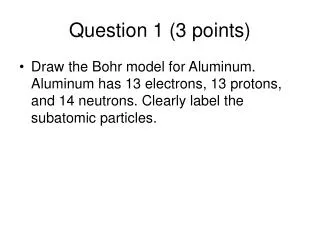
Question 1 (3 points) • Draw the Bohr model for Aluminum. Aluminum has 13 electrons, 13 protons, and 14 neutrons. Clearly label the subatomic particles.
Question 2 (1 point) • How many valence electrons does aluminum have? (Hint: look at your answer for question 1)
Question 3 (1 point) • Who developed the first atomic theory? • A. John Dalton • B. J.J. Thomson • C. Ernest Rutherford • D. Niels Bohr
Question 4 (4 points) • Complete the following data table:
Question 5 (1 point) • True or False. Atoms make up all living things only.