Understanding Economic Sectors: The Role of Agriculture in Economic Development
This exploration of economic activities categorizes the economy into five sectors: primary (agriculture, extraction), secondary (manufacturing, construction), tertiary (services), quaternary (information management), and quinary (executive decision-making). Agriculture has historically been the backbone of economies, employing 40% of the global population. Despite advances in mechanization and farm consolidation leading to fewer farmers, agricultural production remains at an all-time high. The relationship between food production and cultural practices underscores its significance in human history.

Understanding Economic Sectors: The Role of Agriculture in Economic Development
E N D
Presentation Transcript
Agriculture and the Development of Economics
Basic Economic Structure • There are 5 sectors of the economy: • Primary: Agriculture, gathering/extracting • Secondary: Manufacturing, processing, construction, power production • Tertiary: Retail/wholesale trade, personal and professional services • Quaternary: Information, research, management • Quinary: Executive decision makers
Classification of Economic Activities • Primary or Extractive Activities Hunting & Gathering • Farming • Livestock raising or herding • Lumbering • Mining • Quarrying • Working in the natural environment-often the environment suffers.
Primary or Extractive Economy- Teak logs near Mandalay, Myanmar
Top picture-aquaculture or fish farming in Thailand Right-fishing, one of the most dangerous occupations in the world, is vital to many countries (Iceland, Japan, etc.), but fish stocks are running low due to over fishing in many parts of the world
Classification of Economic Activities • Secondary Activities • The stages are: • Stone Age- • Copper Age- • Bronze Age- • Iron Age, etc. • Manufacturing-converting raw materials into finished goods. • Major changes in human history marked by new ways to convert raw materials into finished good.
Classification of Economic Activities • Tertiary Activities provide essential services in a complex society • Doctors, dentist, hospitals • Lawyers • Teachers • Stores, shops • Banks, offices • Quaternary and Quinary are high tech and specialization • Administration • Research
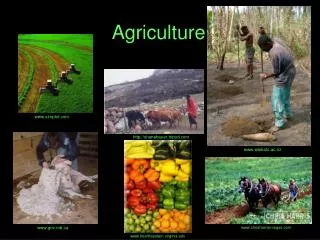
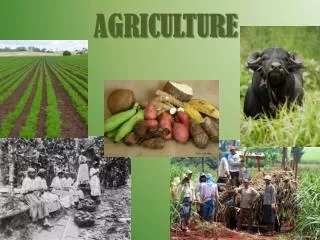
Agriculture Agriculture – the purposeful tending of crops and raising of livestock in order to produce food and fiber.
The Persistence of Agriculture • The US only has 2 million farmers. • Mechanization and farm consolidation have forced out many small scale farmers. • Yet US farm production is at an all time high. • IN MOST OF THE WORLD-AGRICULTURE REMAINS THE LEADING EMPLOYMENT SECTOR-40% of the world’s population are farmers
Before Farming • Food production, preparation and consumption plays a major role in all culture. • Food taboos by custom or religion, food intolerances-dairy, eggs or fish, peanuts, etc. • Hunting & Gathering or Fishing was the only way to acquire food for most of our existence. • San of southern Africa • Aboriginals of Australia • Native Americans of Brazil