
SlideServe
Menu
Préférences
© SlideServe · v2026

Chapter 3 (Part 3): Maximum-Likelihood and Bayesian Parameter Estimation (Section 3.10)

jackson-daniel avatar
19 diapositives · 381 Views · Nov 09, 2014

Pattern Classification All materials in these slides were taken from Pattern Classification (2nd ed) by R. O. Duda, P. E. Hart and D. G. Stork, John Wiley & Sons, 2000 with the permission of the authors and the publisher.
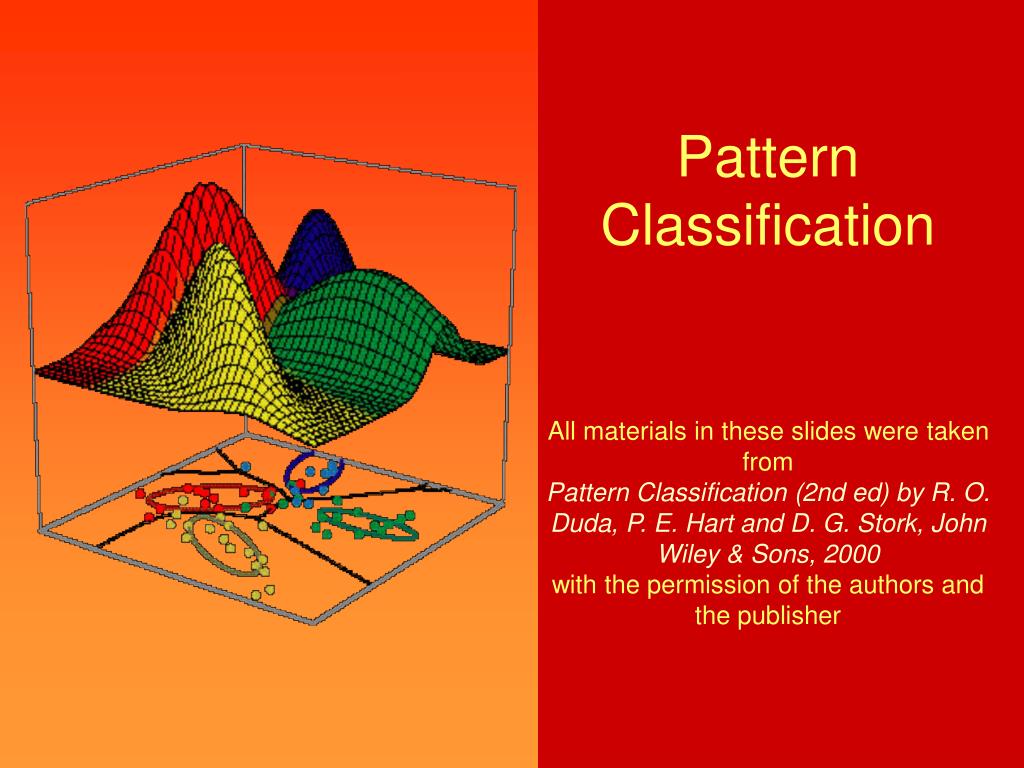
Chapter 3 (Part 3): Maximum-Likelihood and Bayesian Parameter Estimation (Section 3.10) - slide 1
01 / 19Chapter 3 (Part 3): Maximum-Likelihood and Bayesian Parameter Estimation (Section 3.10)
1 / 17

Télécharger la présentation

Chapter 3 (Part 3): Maximum-Likelihood and Bayesian Parameter Estimation (Section 3.10)
Une image / un lien ci-dessous est fourni (tel quel) pour télécharger la présentation

Politique de téléchargement : le contenu du site vous est fourni TEL QUEL pour votre information et votre usage personnel ; il ne peut être vendu, concédé sous licence ni partagé sur d’autres sites sans l’accord de son auteur.Le contenu vous est fourni TEL QUEL, pour votre information et votre usage personnel uniquement. Téléchargez la présentation en cliquant sur ce lien. Lors du téléchargement, si vous ne parvenez pas à télécharger une présentation, l’éditeur a peut-être supprimé le fichier de son serveur.Pendant le téléchargement, si vous ne parvenez pas à obtenir une présentation, le fichier a peut-être été supprimé par l’éditeur.

F I N

Plus de contenu associé

Transcription de la présentation
  1. Pattern ClassificationAll materials in these slides were taken from Pattern Classification (2nd ed) by R. O. Duda, P. E. Hart and D. G. Stork, John Wiley & Sons, 2000with the permission of the authors and the publisher

  2. Chapter 3 (Part 3): Maximum-Likelihood and Bayesian Parameter Estimation (Section 3.10) Hidden Markov Model: Extension of Markov Chains

  3. Pattern Classification, Chapter 3 (Part 3)

  4. Hidden Markov Model (HMM) • Interaction of the visible states with the hidden states bjk= 1 for all j where bjk=P(Vk(t) | j(t)). • 3 problems are associated with this model • The evaluation problem • The decoding problem • The learning problem Pattern Classification, Chapter 3 (Part 3)

  5. The evaluation problem It is the probability that the model produces a sequence VT of visible states. It is: where each r indexes a particular sequence of T hidden states. Pattern Classification, Chapter 3 (Part 3)

  6. Using equations (1) and (2), we can write: Interpretation: The probability that we observe the particular sequence of T visible states VT is equal to the sum over all rmax possible sequences of hidden states of the conditional probability that the system has made a particular transition multiplied by the probability that it then emitted the visible symbol in our target sequence. Example:Let 1, 2, 3 be the hidden states; v1, v2, v3be the visible states and V3 = {v1, v2, v3} is the sequence of visible states P({v1, v2, v3}) = P(1).P(v1 | 1).P(2 | 1).P(v2 | 2).P(3 | 2).P(v3 | 3) +…+ (possible terms in the sum= all possible (33= 27) cases !) Pattern Classification, Chapter 3 (Part 3)

  7. v1 v2 v3 First possibility: Second Possibility: P({v1, v2, v3}) = P(2).P(v1 | 2).P(3 | 2).P(v2 | 3).P(1 | 3).P(v3 | 1) + …+ Therefore: 1 (t = 1) 3 (t = 3) 2 (t = 2) v1 v2 v3 2 (t = 1) 3 (t = 2) 1 (t = 3) Pattern Classification, Chapter 3 (Part 3)

  8. Evaluation • HMM forward • HMM backward • Example 3. • HMM Forward Pattern Classification, Chapter 3 (Part 3)

  9. Pattern Classification, Chapter 3 (Part 3)

  10. Pattern Classification, Chapter 3 (Part 3)

  11. Pattern Classification, Chapter 3 (Part 3)

  12. Left-to-Right model(speech recognition) Pattern Classification, Chapter 3 (Part 3)

  13. The decoding problem (optimal state sequence) Given a sequence of visible states VT, the decoding problem is to find the most probable sequence of hidden states. This problem can be expressed mathematically as: find the single “best” state sequence (hidden states) Note that the summation disappeared, since we want to find Only one unique best case ! Pattern Classification, Chapter 3 (Part 3)

  14. Where:  = [,A,B]  = P((1) = ) (initial state probability) A = aij = P((t+1) = j | (t) = i) B = bjk = P(v(t) = k | (t) = j) In the preceding example, this computation corresponds to the selection of the best path amongst: {1(t = 1),2(t = 2),3(t = 3)}, {2(t = 1),3(t = 2),1(t = 3)} {3(t = 1),1(t = 2),2(t = 3)}, {3(t = 1),2(t = 2),1(t = 3)} {2(t = 1),1(t = 2),3(t = 3)} Pattern Classification, Chapter 3 (Part 3)

  15. Decoding • HMM decoding • Example 4 • Might have invalid path Pattern Classification, Chapter 3 (Part 3)

  16. Pattern Classification, Chapter 3 (Part 3)

  17. The learning problem (parameter estimation) This third problem consists of determining a method to adjust the model parameters  = [,A,B] to satisfy a certain optimization criterion. We need to find the best model Such that to maximize the probability of the observation sequence: We use an iterative procedure such as Baum-Welch or Gradient to find this local optimum Pattern Classification, Chapter 3 (Part 3)

  18. Learning • The Forward-Backward Algorithm • Baum-Welch Algorithm Pattern Classification, Chapter 3 (Part 3)

  19. by Eq. 140 by Eq. 141 Pattern Classification, Chapter 3 (Part 3)