Understanding Inventory Management: Costs, Methods, and Reporting
This comprehensive guide covers the essentials of inventory management, highlighting the costs associated with holding inventories, such as interest, space, and potential obsolescence. It discusses methods for tracking inventory, including FIFO, LIFO, and weighted average. The basic relationship between beginning inventory, purchases, ending inventory, and the cost of goods sold is explained with practical examples. Additionally, different inventory production types, reporting requirements, and the implications of inventory valuation methods are examined to enhance your understanding of effective inventory management.

Understanding Inventory Management: Costs, Methods, and Reporting
E N D
Presentation Transcript
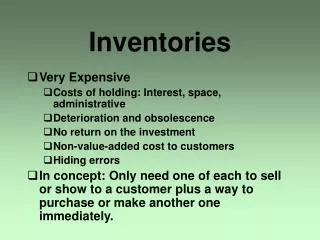
Inventories • Very Expensive • Costs of holding: Interest, space, administrative • Deterioration and obsolescence • No return on the investment • Non-value-added cost to customers • Hiding errors • In concept: Only need one of each to sell or show to a customer plus a way to purchase or make another one immediately.
Basic Relationship • BI + Purchases = Available = CGS + EI • Beginning inventory = $80,000 • Purchases = $100,000 • Available = __________________ • Ending inventory = $40,000 • Cost of goods sold = __________________
Methods • Physical flow--How are the specific products moved or sold? • Assumed flow for costing (cost flow) may be unrelated to physical flow. • Methods acceptable (USA:) • Specific identification • Weighted average • FIFO • LIFO
Which method is most appropriate conceptually (physical=cost flow) for the following inventories? • Million tons of coal in one pile • Fresh food • A 10-million gallon tank of fuel oil • Expensive jewelry pieces
Other Information • If LIFO used for tax, then by law must be used LIFO for the financial report. LIFO not allowed for IFRS. • Periodic inventory--take ending inventory to determine cost of goods sold. • Perpetual inventory--CGS recorded on each sale. • Physical inventory must be taken annually for tax purposes.
Reporting • May use several methods for different inventories. • Disclose methods and proportions if material • Report inventories pledged or assigned.
Lower of Cost or MKT • Inventories reported at LCM: • Cost by one of the acceptable methods Ceiling--Net realizable value=Price-Costs to sell Market = Replacement cost Floor--Ceiling less normal profit
PRODUCTION INVENTORY • Three types: Materials, Work in Process, Finished Goods • Cost of goods manufactured • Materials • Labor • Overhead • BWIP+Mat+Lab+OH-EWIP=Cost of goods manufactured (Purchases for a merchandiser)