Understanding Cell Theory: The Foundation of Life
Explore the fundamental concepts of Cell Theory, which establishes that all organisms are composed of cells, and delve into the history of cell discovery through notable scientists like Robert Hooke and Theodor Schwann. Learn about the differences between prokaryotic and eukaryotic cells, the various organelles and their functions, and how cells perform life functions. Discover the exceptions to cell theory and the processes of photosynthesis and cellular respiration, highlighting the intricate world of cells as the basic building blocks of life.

Understanding Cell Theory: The Foundation of Life
E N D
Presentation Transcript
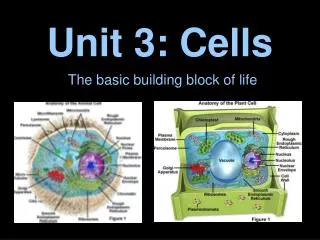
Unit 3: Cells The basic building block of life
A. Cell Theory Discovery of the _________ allows scientists to first view cells. How big are cells? SMALL - ________ (large plant cells) _______ (small bacteria)
1. Time Line and People of the Cell Theory a.___________________ – 1600’s in Holland Discovered ________________ and blood cells through high power simple microscopes.
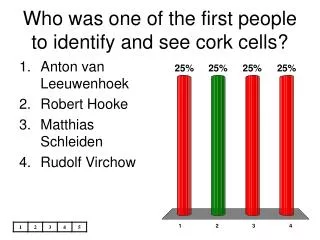
b. _______________ – English scientist in the 1665 Looked at _______ under the microscope _____________________
d. _______________ - 1838 Germany “_____________ were composed of cells” e. _______________ - 1839 Germany “____________ were composed of cell.”
2. Cell Theory a. All organisms are ______________________________ Multicellular or Unicellular b. The cell is the _______________________ / structure of organisms. ____________ happens within a cell All cells carry on ___________________________ c. Cells come from __________________ cells. Belief that life started as single cells and evolved over millions of years.
3. Exceptions to the Cell Theory a. ___________ Small and not made of cells, but has the ability to perform life functions b. Where did the __________ come from? _____________________ life comes from inanimate objects
B. Types of Cells 1.______________ – Prokaryotes - cells that _________________ with membranes - _____________, but they do have DNA - __________ in size, less complex - ex: bacteria and blue-green algae
2. ________________ – Eukaryotes - cells containing __________________ (organelles) surrounded by membranes (have membrane bound organelles) - _____________ and other organelles for specialized chemical reactions - these are the cells you are familiar with because ______________________. - _________________ - ex: protists, fungus, plants, animal cells
C. Cell Organelles (Organelle = “small tool”; perform life functions) 1. ____________ = nuclei (pl) round membrane bound structure ____________ for metabolism and reproduction if removed cell dies contains ________
2. ______________ __________ material in the cell site for many _________________
3. ______________________ = system of fluid filled canals enclosed by membranes - serve as paths for the ____________ of materials - rough or smooth appearance; __________ make it rough
4. ______________ = small particles sites of ________________ lots of them
5. ____________ stacks of ___________________ (pancakes) processing, ___________________ centers
6. _____________ fluid filled membranous sacs ____________________________ Vessicle = small vacuole 7. ____________ specialized vacuole contain strong __________________ White blood cells have lysosomes that break down bacteria
8. _______________ round, oval shaped organelles site for ________________ release energy in food molecules makes ________ Cellular Respiration: • ADP ATP High Energy Bond • Make energy for the cell • C6H12O6 + 6 O236 ATP + 6 H2O + 6 CO2
9. ________________ contain _____________ pigment = catches light site for photosynthesis only in plant cells a. Photosynthesis: Conversion of light energy into a useable form for the cell. 6 CO2 + 6 H2O + Light C6H12O6 + 6 O2 Photosynthesis and Respiration are opposite formulas
10. _____________ protein rod pairs that are at 90 degrees to each other only in ____________ involved in cell division (mitosis). 11. Cilia and Flagella ________________ used for moving the cell flagella are larger; cilia are usually smaller and more plentiful.
12. ____________ located outside the membrane gives shape and provides support Not in Animal Cells.
13. ________________ = plasma membrane a. separates cells from its surroundings - like the skin - makes it possible for the inside of the cell to be _____________________ than the outside b. two layered structure composed of ________ and ________ fluid mosaic model = proteins and lipids move around proteins on outside act as receptors (pick up info) c. Maintains homeostasis by controlling the ________ of materials into and out of the cell.