
SlideServe
Menu
Préférences
© SlideServe · v2026

Exploring Digital Culture: Interdisciplinary Perspectives and Social Implications

jadyn avatar
15 diapositives · 301 Views · Aug 21, 2014

This course provides an in-depth exploration of digital culture and its implications for contemporary society. Students will engage with major disciplines studying cultural and cognitive phenomena, offering a humanistic perspective on digital culture. The seminar-style course encourages active participation through discussions, presentations, and project analyses. Topics include the cybernetic revolution, the nature of culture, the roles of medialogists, and the influence of digital culture on various aspects of life, including globalization, sustainability, and ethics.
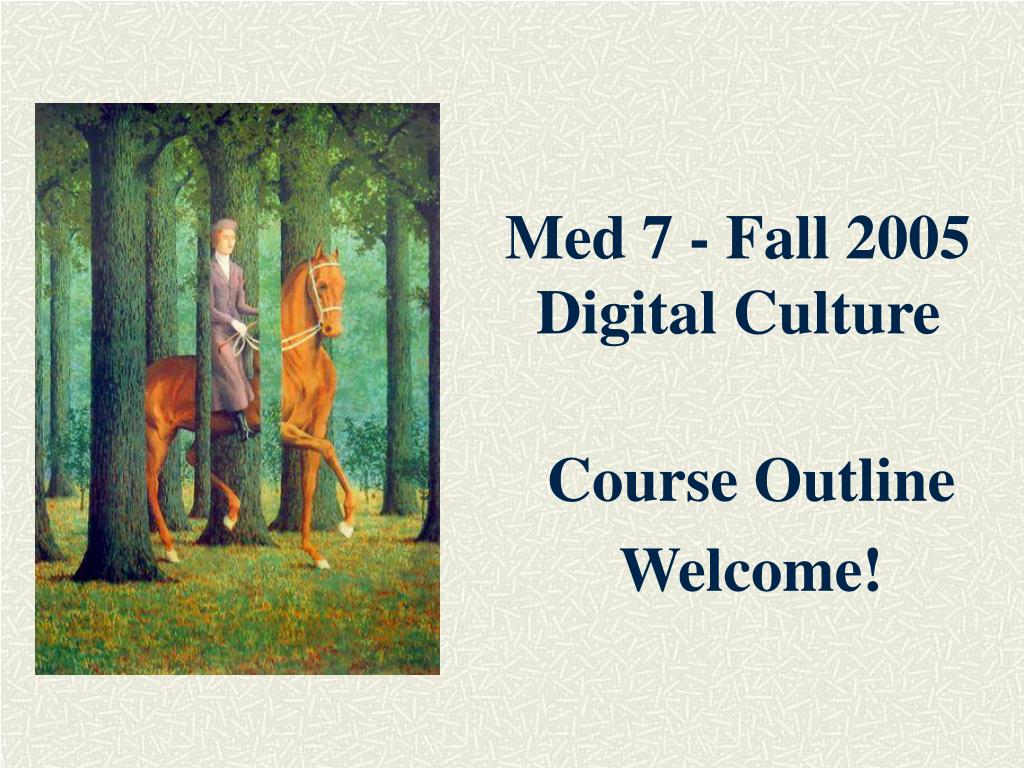
Exploring Digital Culture: Interdisciplinary Perspectives and Social Implications - slide 1
01 / 15Exploring Digital Culture: Interdisciplinary Perspectives and Social Implications
1 / 17

Télécharger la présentation

Exploring Digital Culture: Interdisciplinary Perspectives and Social Implications
Une image / un lien ci-dessous est fourni (tel quel) pour télécharger la présentation

Politique de téléchargement : le contenu du site vous est fourni TEL QUEL pour votre information et votre usage personnel ; il ne peut être vendu, concédé sous licence ni partagé sur d’autres sites sans l’accord de son auteur.Le contenu vous est fourni TEL QUEL, pour votre information et votre usage personnel uniquement. Téléchargez la présentation en cliquant sur ce lien. Lors du téléchargement, si vous ne parvenez pas à télécharger une présentation, l’éditeur a peut-être supprimé le fichier de son serveur.Pendant le téléchargement, si vous ne parvenez pas à obtenir une présentation, le fichier a peut-être été supprimé par l’éditeur.

F I N

Plus de contenu associé

Transcription de la présentation
  1. Med 7 - Fall 2005Digital Culture Course Outline Welcome!

  2. Luis Emilio Brunileb@media.aau.dk My background: • Environmental Engineering • Communication Science and Semiotics • Interdisciplinarity: • Natural and Social Sciences • Art and Science • Culture-Nature relations • Ph. D. Institute of Molecular Biology (KU) • A sign-theoretic approach to biotechnology • Biosensing and signal transduction

  3. Objectives of the course • Provide an understanding of the social implications and the cultural context of the work of the medialogist. • Acquire a comprehensive view of the advent of digital culture in contemporary society. • Review the major disciplines that study cultural and cognitive phenomena. • Provide a humanistic view to digital culture. • Explore the conceptual relations between cognitive processes, communication and behaviour in biological and artificial systems.

  4. Dynamics of the course • The course has the modality of a seminar, with lectures, readings, presentation of articles, discussions and class exercises. • You are expected to participate actively in discussions and to make presentations of selected reading materials and work in progress of your semester projects. • The course is related to the other courses of the Med 7 semester and to your semester projects.

  5. Project analysis • Elaborate a case study in order to develop, analyse and characterise the context, the cultural and the social implications of a case of your interest inrelation to your semester project. • Such analysis of the project should cover the different aspects, dimensions and points of view that will be addressed during the course. • The objective is to make a presentation of your case to the rest of the class. There will be time allocated to work on this analyses in class. In the last session you will present your case for discussion in class. • You are free to choose the media you prefer for this presentation. Be as creative as you want, but remember that the analysis of the case and the conceptual framework that you use are the most important issues of your presentations.

  6. What about you? • Background  past experiences • Medialogy interests • Current projects  semester project • Specialization • Future perspectives  dreams

  7. Topics of the course • The cybernetic ”revolution”. • What is culture? What is digital culture? • The work of the medialogist. • The study of cognitive processes in biological and cultural systems. • Digital culture in the Semiosphere. • Influence and impacts of digital culture in the different aspects of life. • Globalization, Sustainability and the risk society.

  8. 1) The cybernetic revolution • The Myth of the Computer Revolution. • The Defining Moments in Digital Culture. • Information: between nature and culture. • Introduccion to Cybernetics

  9. 2) What is culture? What is digital culture? • A tip for understanding culture  The culture/nature dichotomy. • What is western’s “Modernity”? • Culture as a mental process. • What is non-digital culture? • When did it become digital?What is the difference? • Material supports for cultural products  the media, the channel. • The “flow” of culture, what is it that “flows”?  The content  Where is it generated?

  10. 3) The work of the medialogist • Multimedia. • The integration of technology. • Cross-modal based media. • Creativity. • Towards a definition of medialogy.

  11. 4) The study of cognitive processes in biological and cultural systems. • Sociology of media • Anthropology • Cultural studies • Cultural semiotics • Cognitive sciences  cognitive processes and behaviour in natural and artificial systems. • Biosemiotics  sensation, perception and communication in biological systems. • Umwelt theory  building internal models about the world and its own actions

  12. 5) Digital culture in the Semiosphere • The Semiotic Theory of Culture. • Global communication. • Inter-cultural communication  Cultural diversity  Cultural homogenisation. • Global media and entertainment corporations  Cultural franchising.

  13. 6) Influence and impacts of digital culture in the different aspects of life • Art  Aesthetics • Science • Economy  Finances  Marketing • Education • News • Knowledge vs. Information • Crime • Politics, institutions, democracy and citizens  electronic democracy • Religion

  14. 7) Globalization, Sustainability and the risk society • Sustainable multimedia. • Multimedia related social/health hazzards. • Ethics  Environmental and social responsibility. • Privacy – Exclusion. • Credibility and reliability of information sources. • Information control  information imperialism. • Energy consumption  paper vs. electricity comsumption. • Dependence on digital culture and electricity. • Attention deficit disorder: quantity vs. quality.

  15. Syllabus Date Contents Reading Sept. 6 (am/pm) Introduction to the course. The cybernetic revolution. No reading to be done :-) Sept. 13 (am/pm) Towards a definition of culture. The information age. Appropriate chapter in the compendium Sept. 20 (am/pm) Information, semiotics and cognitive sciences. Appropriate chapter in the compendium Sept. 27 (am/pm) Implications and impacts of digital culture I. The work of the medialogist: applications of digital technology I. Selected articles Oct. 4 (am/pm) Implications and impacts of digital culture II. The work of the medialogist: applications of digital technology II. Selected articles Oct. 11 (am) Digital culture in the Semiosphere. Appropriate chapter in the compendium Nov. 8 (am) Globalization, Sustainability and the risk society. Appropriate chapter in the compendium Nov. 15 (am) Conclusions andpresentations.