Download
1 / 10
100 likes | 233 Vues
This resource covers essential concepts related to forces, energy, and gravity in physical science. Students will explore net forces on various objects, assessing whether they are balanced or unbalanced. Key questions focus on inertia, effects of mass on acceleration, and gravitational forces among planets. The curriculum includes energy types, circuit comparisons, and the principles of static electricity. Students will also reflect on their understanding and performance in assessments, reinforcing their learning through practice questions.

E N D
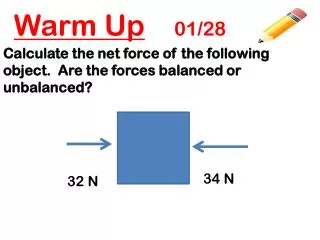
Warm Up01/28 Calculate the net force of the following object. Are the forces balanced or unbalanced? 34 N 32 N
Closing01/28 Practice CRCT Question What is the tendency to resist any change in motion called? a. friction velocity gravity inertia
Warm Up01/29 Practice CRCT Question What happens to a soccer ball’s acceleration when the mass is doubled? It increases. It decreases. It stays the same. It changes direction.
Closing01/29 Practice CRCT Question: Which planet has the greatest gravitational force and why? a. Earth b. Jupiter Pluto Mars
Warm Up01/30 Unit 3 ReviewQuestion List the seven types of energy that we studied and write a “p” if it is mostly potential energy and a “k” if it is mostly kinetic energy. 1. 2. 3. 4. 5. 6 7.
Closing01/30 Unit 3 Reflection Question: How do you think you performed on the test? What questions troubled you the most? Was the quick review at the beginning of the class helpful?
Warm Up01/31 Unpack the Standard and Element S8P5. Students will recognize the characteristics of gravity, electricity, and magnetism as major kinds of forces acting in nature. b. Demonstrate the advantages and disadvantages of series and parallel circuits and how they transfer energy.
Closing01/31 Practice CRCT Question: According to the Law of Electric Charges, if two atoms both have positive charges, how to they react with one another? They move toward one another. They move away from one another. c. They speed up. d. They do not change.
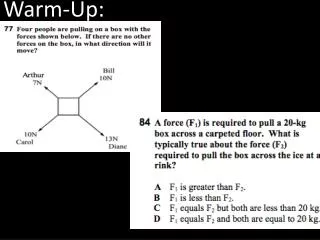
Warm Up02/01 Practice CRCT Question: The figure below shows the horizontal forces that act on a box that is pushed from the left with a force of 12 N. What force is resisting the horizontal motion in this illustration? gravity inertia friction momentum
Closing02/01 Practice Constructed Response Question: What does the word “static” mean in the term static electricity and why do we use that term?