Understanding the Human Circulatory System: Structure and Function of Arteries and Veins
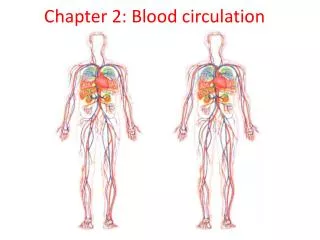
The human circulatory system is essential for transporting oxygen and nutrients to cells, while removing carbon dioxide and other waste products. It consists of three main components: the heart, blood vessels (including arteries, veins, and capillaries), and blood. Arteries carry oxygen-rich blood away from the heart, while veins return oxygen-poor blood. Capillaries facilitate the exchange of materials between blood and tissues. The system's efficiency relies on the heart's rhythmic contractions and the intricate network of blood vessels that ensure proper circulation throughout the body.

Understanding the Human Circulatory System: Structure and Function of Arteries and Veins
E N D
Presentation Transcript
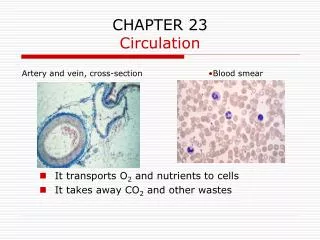
CHAPTER 23Circulation Artery and vein, cross-section • Blood smear • It transports O2 and nutrients to cells • It takes away CO2 and other wastes
Circulatory system • made up of 3 parts • organ • heart • tissues & cells • blood vessels • arteries • veins • capillaries • blood • red blood cells • plasma
The circulatory system associates intimately with all body tissues • Capillaries are microscopic blood vessels • They form an intricate network among the tissue cells Capillary Redbloodcell
The circulatory system associates intimately with all body tissues II • No substance has to diffuse far to enter or leave a cell Capillary Diffusion ofmolecules INTERSTITIALFLUID Tissuecell
The cardiovascular system has two circuits • The pulmonary circuit • conveys blood between the heart and gas-exchange tissues • The systemic circuit • carries blood between the heart and the rest of the body
Circulation of Blood Circulationto lungs • 2 part system • Circulation to lungs(pulmonary) • blood gets O2 from lungs • drops off CO2 to lungs • brings O2-rich blood from lungs to heart • Circulation to body(systemic) • pumps O2-rich blood to body • picks up nutrients from digestive system • collects CO2 & cell wastes lungs heart body Circulationto body
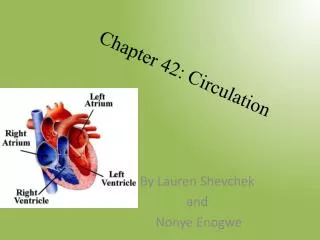
The human heart • 4-Chambered heart • atria (atrium) • thin wall • collection chamber • receive blood • ventricles • thick wall pump • pump blood out leftatrium rightatrium rightventricle leftventricle
Lub-dub, lub-dub • 4 valves in the heart • flaps of connective tissue • prevent backflow • Heart sounds • closing of valves • “Lub” • force blood against closed AV valves • “Dub” • force of blood against semilunar valves • Heart murmur • leaking valve causes hissing sound • blood squirts backward through valve SL AV AV
Blood’s path through the heart • 1. vena cavae • 2. right atrium • 3. valve • 4. right ventricle • 5. valve • 6. pulmonary artery (to lungs) • 7. pulmonary veins • 8. left atrium • 9. valve • 10. left ventricle • 11. valve • 12. aortalargest blood vessel in the body.
Blood vessels arteries veins artery arterioles venules arterioles capillaries venules veins
Arteries: Built for their job • Arteries • blood flows away from heart • thicker walls • provide strength for high pressure pumping of blood • elastic & stretchable • maintains blood pressure even when heart relaxes
Major arteries aorta carotid= to head to brain & left arm to right arm to body pulmonaryartery pulmonaryartery=to lungs coronary arteries
Veins: Built for their job Blood flows toward heart • Veins • blood returns back to heart • thinner-walled • blood travels back to heart at low speed & pressure • why low pressure? • far from heart • blood flows because muscles contract when we move • squeeze blood through veins • valves in large veins • in larger veins one-way valves allow blood to flow only toward heart Openvalve Closed valve
Major Veins superiorvena cava= from upper body pulmonaryvein= from lung pulmonaryvein = from lung inferiorvena cava= from lower body
Structure-function relationship • Capillaries • very thin walls • allows diffusion of materials across capillary • O2, CO2, H2O, food, waste body cell waste CO2 O2 food
The heart contracts and relaxes rhythmically • Diastole • Blood flows from the veins into the heart chambers • Systole • The atria briefly contract and fill the ventricles with blood • Then the ventricles contract and propel blood out
The pacemaker sets the tempo of the heartbeat • The SA node (pacemaker) generates electrical signals that trigger the contraction of the atria • The AV node then relays these signals to the ventricles heart pumping controlled by electrical impulses signal also transmitted to skin = EKG electrocardiogram
Connection: What is a heart attack? • A heart attack is damage that occurs when a coronary feeding the heart is blocked Aorta Rightcoronaryartery Leftcoronaryartery Blockage Dead muscle tissue
Cardiovascular diseases are the leading cause of death in the United States • Blood vessel blockage is usually due to blood clots • Atherosclerosis: Growths called plaques develop in the inner wall of the arteries, narrowing their bore • In some cases, plaques also become hardened by calcium deposits, leading to arteriosclerosis, commonly known as hardening of the arteries Connectivetissue Plaque Smoothmuscle Epithelium
Women & Heart Disease Death rates for heart disease per 100,000 women, 2002 • Heart disease is 3rd leading cause of death among women aged 25–44 years & 2nd leading cause of death among women aged 45–64 years. Risk factors • Smoking • Lack of exercise • High fat diet • Overweight
Blood exerts pressure on vessel walls • Blood pressure depends on • cardiac output • resistance of vessels • Pressure is highest in the arteries • It drops to zero by the time the blood reaches the veins Systolicpressure Diastolicpressure Relative sizes andnumbersof blood vessels
Three factors keep blood moving back to the heart • muscle contractions • breathing • one-way valves
Connection: Measuring blood pressure can reveal cardiovascular problems • Blood pressure is measured as systolic and diastolic pressures • Hypertension is persistent systolic pressure higher than 140 mm Hg and/or diastolic pressure higher than 90 mm Hg • It is a serious cardiovascular problem
STRUCTURE AND FUNCTION OF BLOOD • Blood consists of cells suspended in plasma • Plasma is an aqueous solution of various substances
Blood Cell production ribs, vertebrae, breastbone & pelvis • Stem cells • “parent” cells in bone marrow • differentiate into many different types of cells white blood cells white bloodcells red bloodcells
Blood & blood cells • Blood is a tissue of fluid & cells • plasma • liquid part of blood • dissolved salts, sugars, proteins, and more • cells • red blood cells (RBC) • transport O2 in hemoglobin • white blood cells (WBC) • defense & immunity • platelets • blood clotting
Red blood cells • transport oxygen • Small round cells • produced in bone marrow • 5 liters of blood in body • 5-6 million RBC in drop of human blood • last 3-4 months (120 days) • filtered out by liver • ~3 million RBC destroyed each second
Hemoglobin • Protein which carries O2 • 250,000 hemoglobins in 1 red blood cell O2 O2 O2 O2
White blood cells help defend the body • White blood cells (leukocytes) • function both inside and outside the circulatory system • They fight infections and cancer
Blood clots plug leaks when blood vessels are injured • When a blood vessel is damaged, platelets respond • They help trigger the formation of an insoluble fibrin clot that plugs the leak
Connection: Stem cells offer a potential cure for leukemia and other blood cell diseases • All blood cells develop from stem cells in bone marrow • Such cells may prove valuable for treating certain blood disorders