Download

1 / 13
130 likes | 264 Vues
This guide explores the concept of power series, focusing on their definitions, convergence behaviors, and applications. It explains how infinite series can approach a limiting value and discusses the criteria for convergence or divergence. Key examples illustrate geometric series and the step-by-step process of deriving new series. Additionally, we detail how to approximate functions using power series for accurate calculations. Whether you're learning about partial sums or exploring transcendental functions, this guide provides the clarity needed for mastering power series.

E N D
9.1 Power Series
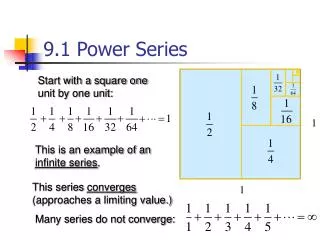
Start with a square one unit by one unit: 1 This is an example of an infinite series. 1 This series converges (approaches a limiting value.) Many series do not converge:
If Sn has a limit as , then the series converges, otherwise it diverges. In an infinite series: a1, a2,… are terms of the series. an is the nth term. Partial sums: nth partial sum
This converges to if , and diverges if . is the interval of convergence. Geometric Series: In a geometric series, each term is found by multiplying the preceding term by the same number, r.
a r Example 1:
a r Example 2:
If then If and we let , then: The partial sum of a geometric series is: The more terms we use, the better our approximation (over the interval of convergence.)
A power series is in this form: or The coefficientsc0, c1, c2… are constants. The center “a” is also a constant. (The first series would be centered at the origin if you graphed it. The second series would be shifted left or right. “a” is the new center.)
Example 3: multiply both sides by x. To find a series for Once we have a series that we know, we can find a new series by doing the same thing to the left and right hand sides of the equation. This is a geometric series where r=-x.
So: Example 4: Given: find: We differentiated term by term.
hmm? Example 5: Given: find:
The previous examples of infinite series approximated simple functions such as or . This series would allow us to calculate a transcendental function to as much accuracy as we like using only pencil and paper! p