Understanding Motion: From Stars to Planets - The Insights of Galileo, Kepler, and Newton
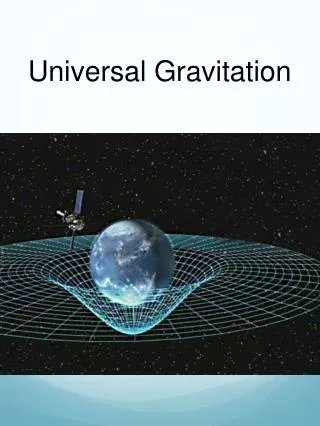
This chapter explores the mechanics of celestial motion, laying out how stars, planets, and comets move in space. It highlights the historical contributions of Tycho Brahe, who advocated for an Earth-centered model, Galileo, Kepler, and Newton, who developed the heliocentric theory and the laws governing planetary motion. The chapter presents Kepler's laws describing elliptical orbits, the speed of planets, and Newton's universal gravitation law, including Cavendish's experiments that confirmed gravitational principles. This foundational knowledge connects astronomical observations to mathematical laws.

Understanding Motion: From Stars to Planets - The Insights of Galileo, Kepler, and Newton
E N D
Presentation Transcript
Universal Gravitation Chapter 8
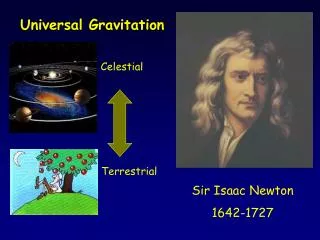
8.1 Motion in the Heavens and on Earth • Stars - regular path • Planets - wanderers, complicated path • Comets - more erratic path Galileo, Kepler, & Newton provided insight into how objects move.
Tycho Brahe observed eclipse of sun & vowed to become astronomer. • Persuaded King Frederick I of Denmark to give him the island of Hven as observatory. • Worked for 20 years there.
In 1597, became astronomer to Emperor Rudolph of Bohemia where his assistant was Kepler. • Brahe - earth centered • Kepler - sun centered • Analyzed Brahe’s data and formulated three laws of motion.
Three Laws • 1. Path of planets are ellipses with the sun at the center. • 2. An imaginary line from the sun to planet sweeps out equal areas in equal time intervals. Move fastest when closest to the sun. • 3. (Ta/Tb)2 = (ra/rb)3
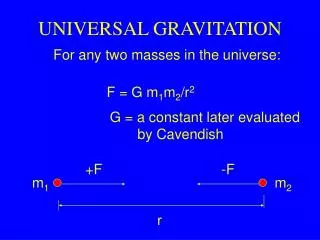
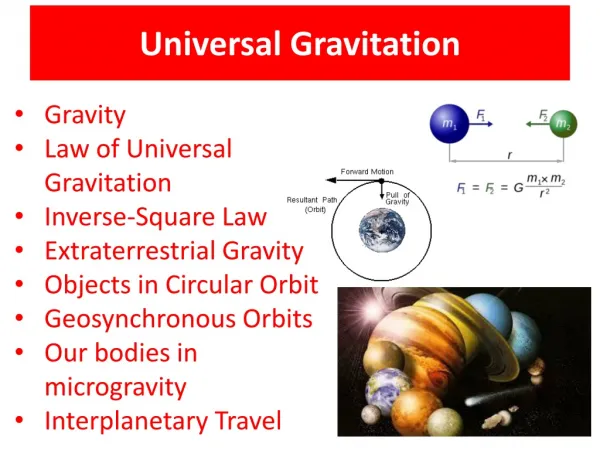
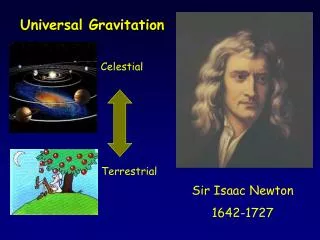
Table 8-1 Planetary Data p 178 • Newton used mathematical properties to prove Kepler’s first law. • F 1/d2 • F = G (m1m2/d2) • Because force depends on 1/d2, its called the inverse square law.
mp = mass of planet • ms = mass of sun • r = radius of planet’s orbit • T= time for one revolution • G = universal gravitation constant • F = ma F = mpac
G(ms mp/ r2) = mp(42r/T2) • T2 = (42/Gms)r3 which is Kepler’s third law • Cavendish tested law of universal gravitation between small masses on Earth.
Able to measure the constant G in Newton’s Law of Universal Gravitation. • Me = 5.98E24 kg
References • http://www.walter-fendt.de/ph11e/keplerlaw1.htm • http://www.walter-fendt.de/ph11e/keplerlaw2.htm • http://www.physicsclassroom.com/mmedia/circmot/ksl.html • http://www.pbs.org/wgbh/nova/einstein/relativity/ • http://www.spaceref.com/tools/vi.html?id=139&cat=blackholes&imgs=movie • http://www.physicsclassroom.com/mmedia/specrel/lc.html