Meter in Poetry
50 likes | 201 Vues
Discover the intricacies of rhythm in poetry through a detailed discussion on stressed and unstressed syllables. Learn how to identify which syllables are stressed with practical approaches and explore the rules governing meter. This guide also introduces specific metrical feet, such as iambs, trochees, and anapests. Through examples and techniques, you will enhance your understanding of poetic structure, enabling you to create or analyze poetry more effectively.


Meter in Poetry
E N D
Presentation Transcript
Meter in Poetry A nuts and bolts discussion which leads to understanding
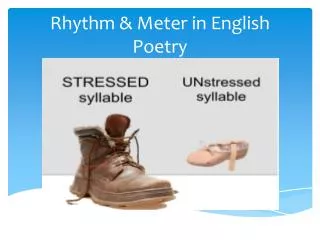
Rhythm (Def) the pattern of stressed and unstressed syllables. A good Question: • How do I figure out the which syllables are stressed!? • -Figuring this out is tricky, there are actually rules, follow the link above to see them. Otherwise, the best method is to really stress each syllable in the word and try a few different variations; this is not a perfect method, but it will get you close. (Syllables with long vowels and “r-controlled” syllables seem to be stressed more often. Short, common words like: a, to, and are mostly unstressed. By no means are these hard and fast rules.)
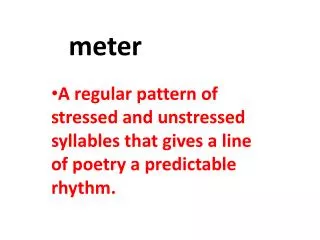
Meter (Def) when the rhythm of stressed and unstressed syllables is regular rather than irregular. Meter is measured in units called feet. Each stressed syllable with its associated unstressed syllables is a foot.
Some Meters Have Special Names • iamb • trochee • dactyl • anapest • alack (a-lack) • the day (the day) • gallant (gal-lant) • hickory (hick-or-y) • understand (un-der-stand)
Try it Gaily bedight A gallant knight In sunshine and in shadow Gai-ly be-dight A gal-lant knight In sun-shine and in shad-ow.