Download
1 / 12
120 likes | 236 Vues
Learn about the Dedza Safety Nets Pilot Project, testing and monitoring community transfer mechanisms and welfare benefits impact on rural poor. The project aims to inform future scaled-up welfare programs through careful analysis and assessment. Various tools and methodologies are employed, including surveys, committee meetings, and expenditure pattern records. Three types of equal value transfers are conducted - cash, vouchers, and in-kind goods. Monitoring is categorized into closely monitored and hands-off approaches across different village committees and beneficiary types. The pilot project involves 386 villages in Linthipe and Kabwazi, with 54 randomly selected for study to assess different transfer types, committee structures, and monitoring levels. This comprehensive approach ensures a thorough evaluation of the project's outcomes and impacts for future policy design.

E N D
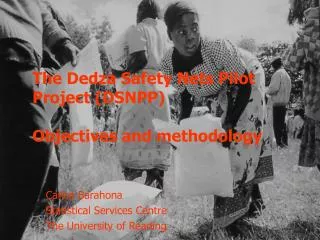
The Dedza Safety Nets Pilot Project (DSNPP)Objectives and methodology Carlos Barahona Statistical Services Centre The University of Reading
DSNPP • Pilot of direct welfare transfers (DWT) to the work-constrained rural poor • Run by Concern Universal in Dedza • M&E support from Calibre Consultants and the SSC at the University of Reading • Lessons will inform the design of a scaled-up DWT programme
Objectives of the pilot The pilot aims to test and monitor: • Community management structures and transfer mechanisms • Whether the benefits reach the beneficiaries • The impact of the transfers on the well-being of beneficiaries • Logistics and cost • Consumer demand and the retail sector
The process of the Dedza Safety Nets Pilot Project
M&E tools • Impact on beneficiaries • Baseline and final impact surveys • Quarterly monitoring surveys • Process as managed by village committees • Minutes of committee meetings • Records of receipt of transfers by beneficiaries • Expenditure pattern • Receipts from vouchers • Surveys • Logistics and costs • CU officers’ records • CU accounts
The transfers Three types, all of equal value = MK 550/month • Cash • Vouchers • In-kind • A pack of goods in September 2001 that comprised: 2 blankets, 6 plates, 1 metal cooking pot, 1 pail, 10 tablets of washing soap and 10 tablets of bathing soap. • Oct - Dec 2001: 20 kg of maize flour • Jan - May 2002: 15 kg of maize flour
The village committees • Three types: • Democratically elected • Village head • Beneficiary/carer
Monitoring intensity • Two intensities: • Closely monitored • Hands-off
Closely monitored Closely monitored Closely monitored Village Head Village Head Village Head Hands-off Hands-off Hands-off Closely monitored Closely monitored Closely monitored Democratic Democratic Democratic In-kind Cash Vouchers Hands-off Hands-off Hands-off Closely monitored Closely monitored Closely monitored Beneficiaries Beneficiaries Beneficiaries Hands-off Hands-off Hands-off The resulting interventions 18 different interventions 3 villages with each type 54 villages
Sampling and design • 386 villages in Linthipe and Kabwazi • 54 villages selected at random for the study • This design allows us to assess: • Differences between different types of transfer, types of committee, levels of monitoring • Any interactions between factors