Maximizing Learning Through Cooperative Learning in Engineering Education
Understand the benefits and types of cooperative learning for improved learning, engagement, and teamwork in engineering education. Learn requirements, benefits, and concerns for successful group-based learning.

Maximizing Learning Through Cooperative Learning in Engineering Education
E N D
Presentation Transcript
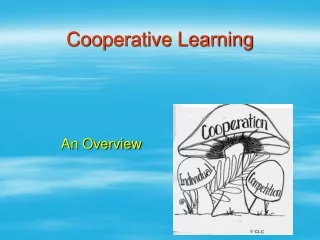
Cooperative Learning Better learning through teamwork Gateway Engineering Education Coalition
Cooperative Learning • What is cooperative learning? • Benefits • What makes a group “cooperative”? • Three types of cooperative learning groups • Concerns • References Gateway Engineering Education Coalition
What is it? • Cooperative learning is working actively • in small groups • to maximize learning • toward a common goal Gateway Engineering Education Coalition
Benefits of Cooperative Learning • Cooperative learning has been studied exhaustively over the last 90 years • More is known about cooperative learning than nearly any other aspect of education • Cooperative learning results in improved: • Learning • Understanding • Recall • Self-esteem Gateway Engineering Education Coalition
Benefits of Cooperative Learning • Positive peer relationships are essential to success in college • Cooperation among students results in: • Higher achievement • Greater productivity • Improved relationships • Better emotional health Gateway Engineering Education Coalition
Benefits of Cooperative Learning • Cooperative learning can revitalize students and faculty • Working together allows students to: • Learn more • Enjoy learning • Develop skills • Especially important because real world work is group work Gateway Engineering Education Coalition
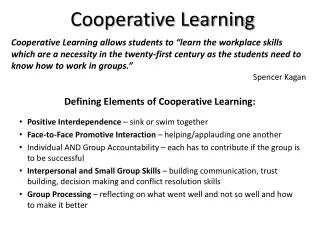
What are the requirements? • Cooperative learning requires • Positive interdependence • Individual accountability • Face-to-face interaction • Teamwork skills • Group processing Gateway Engineering Education Coalition
Positive Interdependence • Individual success depends on the team’s success • Require consensus • Assign roles • Share resources • Individual reward based on team’s success Gateway Engineering Education Coalition
Individual Accountability • Individual accountability reinforces positive interdependence • Evaluate performance individually and collectively • Peer evaluation Gateway Engineering Education Coalition
Face-to-face Interaction • Cooperative learning requires face-to-face interaction • Interaction can be structured • Provide sufficient time for interaction Gateway Engineering Education Coalition
Teamwork Skills • Students often lack teamwork skills • Identify relevant social skills • Active listening • Expression of differences • Teamwork taught like course material • Monitor and assess Gateway Engineering Education Coalition
Group Processing • Group processing needed to keep a team functioning smoothly • Regularly review performance • Explain purpose and relationship to social skills Gateway Engineering Education Coalition
Cooperative Learning Groups • Three types of cooperative learning groups • Informal groups • Formal groups • Base groups Gateway Engineering Education Coalition
Informal Groups • Temporary groups of short duration • No more than one class period • Focus attention on material to be learned • Particularly useful when attention begins to lapse Gateway Engineering Education Coalition
Formal Groups • Centered around a single task • Size, duration, and composition is task dependent • Team activities emphasize: • Discussion, Application, and Mastery • Students work to accomplish shared goals • Formal evaluation Gateway Engineering Education Coalition
Base Groups • Long term cooperative learning groups that provide support for student development • Not focused on a particular task • Duration of one or more terms • Teams should be heterogeneous • Instituted by course, college, or department Gateway Engineering Education Coalition
Concerns • Spending all this time on group exercises will prevent me from getting through the syllabus. • Effective group work requires little in-class time • Pose questions to small groups • Successful teaching is more than covering the syllabus. What matters is how much was actually learned. • Handouts can supplement lectures Gateway Engineering Education Coalition
Concerns • Without lecture I will lose control of the class • That is one point of view • On the other hand…several times during class students may become actively immersed in the material you’re trying to get them to learn Gateway Engineering Education Coalition
Concerns • What if students resent the approach? • Prepare students for it from the beginning • Explain why you are doing it • Better grades • Teaching to others aids understanding • Professional training Gateway Engineering Education Coalition
Concerns • What about students who want to get credit without actively participating in the work? • Always a danger • Include provisions to ensure individual accountability • Call randomly on individuals • Peer evaluations Gateway Engineering Education Coalition
References • www.ncsu.edu/felder-public/Papers/Coopreport.html • Cooperative Learning: Making “Groupwork” Work, Karl A. Smith in Using active learning in college classes: A range of options for faculty. Tracey E. Sutherland & Charles C. Bonwell (eds.) New Directions for Teaching and Learning 67, Jossey-Bass,San Francisco. • www.ncsu.edu/felder-public/Papers/Resist.html • Felder, Richard M., Brent, Rebecca, Effective Strategies for Cooperative Learning, J. Cooperation & Collaboration in College Teaching, 10(2), 69-75, 2001. Gateway Engineering Education Coalition
References • teaching.berkeley.edu/bgd/collaborative.html • home.capecod.net/~tpanitz/ebook/Quotes.html • www.ku.edu/~cte/resources/teachingtips/cooperative.html • scholar.lib.vt.edu/ejournals/JTE/jte-v7n1/gokhale.jte-v7n1.html • www.edletter.org/past/issues/2000-mj/models.shtml • www.ntlf.com/html/lbi/bib/92-2dig.htm • clte.asu.edu/active/mainde.htm Gateway Engineering Education Coalition