
Classical Greece
E N D
Presentation Transcript
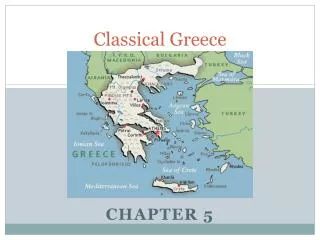
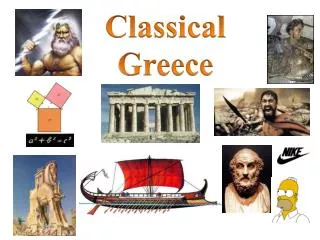
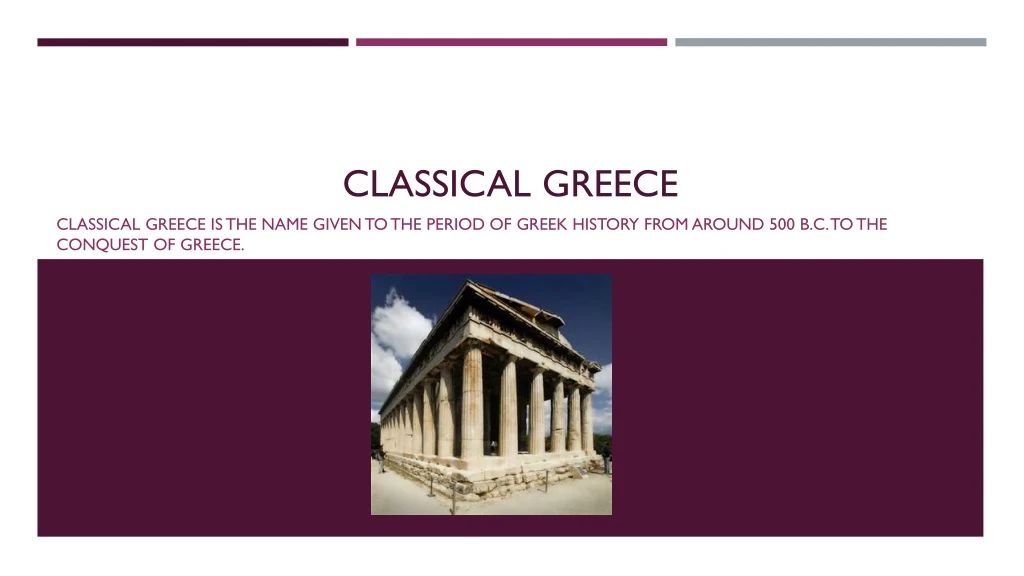
Classical Greece Classical Greece is the name given to the period of Greek history from around 500 B.C. to the conquest of Greece.
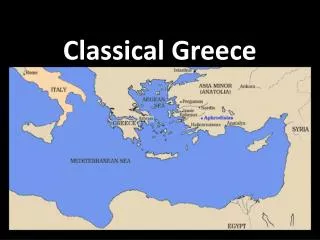
The challenge of Persia • Greeks spread throughout the Mediterranean. • The Greeks and Persian Empire came in contact with each other. • Because the Athenian navy had helped the Ionian Greek cities in Western Asia Minor with a revolt against the Persians, the Persian ruler Darius seeked revenge against the Athenians. • 490 B.C. Persians landed on the plain of Marathon • The Persians were outnumbered by the Athenians. • The Athenians attacked and defeated the Persians. The battle was called the “Battle of Marathon”. • Darius died and Xerxes became the new Persian monarch. • Xerxes led a massive invasion force into Greece. • Athenians and Spartans joined forces in order to defeat Persian invaders, the Greeks won.
The Athenian empire • Athens took over the leadership of the entire Greek world. • Formed a defensive alliance against the Persians known as Delian League. • Pericles a dominant figure in Athenian politics. • Expanded empire abroad, democracy flourished at home. • Classical Athenian and Greek history, AKA :the Age of Pericles”
The great Peloponnesian war • Greeks were divided into two camps: the Athenian Empire and Sparta and its supporters. • Athens and Sparta built two very different societies. • Sparta feared the growing Athenian Empire: a series of disputes led to the outbreak of the Peloponnesian War in 431 B.C. • 2nd year of the war a plague broke out in Athens killing over 1/3 of the people. • The Athenian Empire was destroyed in 405 B.C. • The Great Peloponnesian war weakened the major Greek states.
The culture of classical Greece • Classical Greece, especially Athens under Pericles rule, witnessed a period of remarkable intellectual and cultural growth that became the main source of western culture. • Aristotle, Socrates, and Plato established the foundations of western philosophy.
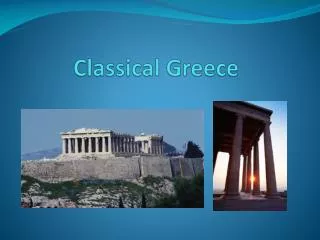
Classical Greek Arts and Literature • Greece produced groundbreaking art and literature that is still considered relevant. • ARCHITECTURE AND SCULPTURE • Most important form the temple • Columns that were once made of wood and then marble • Famous building in Athens the Parthenon example of a classical Greek temple, dedicated to Athena. • Greek sculptures: lifelike statues of the male nude having a related attitudes, their bodies smothered and muscled.
drama • Drama we know today was create by the Greeks • Outdoor theaters • 1st dramas were tragedies • Sophocles a great Athenian playwright and Euripides.
The Writing of history • Herodotus wrote “History of the Persian Wars” often seen as the first real history in Western Civilizations. • Thucydides – the greatest historian of the ancient world. • Pythagoras – the Pythagorean theorem, he taught the essence of the universe could be found in music and numbers.
socrates • Philosopher, sculptor • Believed the goal of education was only to improve the individual. • Socratic method of teaching, uses a question-and-answer format to lead pupils to see things for themselves by using their own reason. • Socrates questioned authority, this got him in trouble. • He was accused and convicted of corrupting the youth. • Sentenced to death by drinking hemlock, a poison
Plato • Student of Socrates • Considered by many as the greatest philosopher of western civilization • Fascinated with reality, How do we know what is real? • Looked for truth beyond the appearance of everyday objects.
Aristotle • Student of Plato • Didn’t accept Plato’s theory of ideal forms • Thought that by examining individual objects (trees), we could perceive their form (treeness). • Believed people happiness was tied to their behavior • Studied natural science by making and recording observations.