Understanding Parametric vs. Cartesian Graphs in AP Calculus: Position, Motion, and Change
This resource delves into the differences between parametric and Cartesian graphs, essential for AP Calculus students. It explains how parametric equations incorporate initial position and orientation, using time as a parameter. The material includes steps for eliminating parameters, utilizing the Pythagorean identities, and finding derivatives to determine rates of change. Examples with detailed interpretations guide learners through finding tangent lines and identifying horizontal and vertical tangents, ensuring a comprehensive understanding of parametric functions.


Understanding Parametric vs. Cartesian Graphs in AP Calculus: Position, Motion, and Change
E N D
Presentation Transcript
2012 Parametric Functions AP Calculus : BC BONUS
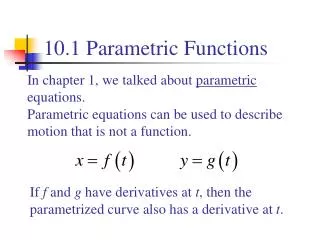
Parametric vs. Cartesian Graphs Adds- initial position and orientation (x , y ) a position graph x = f (t) adds time, y = g (t) motion, and change ( f (t), g (t) ) is the ordered pair t and are called parameters.
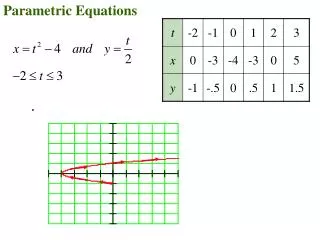
Parametric vs. Cartesian graphs (by hand) t x y -2 -1 0 1 2 3
Parametric vs. Cartesian graphs (calculator) t x y 0 /2 3/2 2 MODE: Parametric ZOOM: Square Try this. Parametric graphs are never unique!
Eliminate the Parameter Algebraic: Solve for tand substitute.
Trig: Use the Pythagorean Identities. Get the Trig function alone and square both sides. Eliminate the Parameter
Insert a Parameter Easiest: Let t equal some degree of x or y and plug in.
The Derivative finds the RATE OF CHANGE. Calculus! Words!
Example 1: Eliminate the parameter. and
The Derivative finds the RATE OF CHANGE. x = f (t) then finds the rate of horizontal change with respect to time. y = g (t) then finds the rate of vertical change with respect to time. (( Think of a Pitcher and a Slider.)) Calculus! still finds the slope of the tangent at any time.
Example 2: a) Find and interpret and at t = 2 b) Find and interpret at t = 2.
Example 3: Find the equation of the tangent at t = ( in terms of x and y ) Find the POINT. Find the SLOPE. Graph the curve and its tangent
Example 4: Find the points on the curve (in terms of x and y) , if any, where the graph has horizontal and/or vertical tangents Horizontal Tangents Slope = 0 therefore, numerator = 0 Vertical Tangent Slope is Undefined therefore , denominator = 0
The Second Derivative Find the SECOND DERIVATIVE of the Parametric Function. 1). Find the derivative of the derivative w/ respect to t. 2). Divide by the original .
Example 1: Find the SECOND DERIVATIVE of the Parametric Function. =
Last Update: • 10/19/07