Understanding Linear Equations: Slope and Line Relationships
This resource explores the fundamentals of linear equations and their graphical representations. It covers the definitions of dependent and independent variables, the concept of slope as the rate of change, and various forms of linear equations including the slope-intercept, point-slope, and standard forms. Learn how to find equations for lines based on given points, understand special relationships between lines—such as parallel and perpendicular lines—and master the calculation of slopes from two points. Engage with practical examples and problems to reinforce your understanding.

Understanding Linear Equations: Slope and Line Relationships
E N D
Presentation Transcript
Linear Equations Linear Function: Functions whose graph is a line. Dependent Variable: y is a dependent variable of x because y is the output of x. Independent Variable: x is an independent variable because x is your input values.
Slope Dude http://www.teachertube.com/viewVideo.php?title=Slope_Dude&video_id=125151
Slope is the rate of vertical change to the horizontal change of a line. • Slope: • Where are two points
Pick two points on the line. Starting with the left most point, count rise and run When counting rise: Up is positive rise Down is negative rise When counting run: Right is positive run Left is negative run
1) 2) 3) 4)
Special Cases in Slope Vertical Lines: lines with zero change is the x values have an UNDEFINED slope Horizontal Lines: lines with zero change in the y values and have a ZERO slope
y-intercept form: • x and y are our variables • mis our slope • b is our y-intercept or where the line crosses the y-axis y-intercept RUN RISE Slope
y = (½)x + 3 2) y= -3x 3) y = 5
1) y = (-1/4)x - 2 2) y = x 3) y = (3/4)x + 1 4) y = -2x + 4
Standard Form: Where A, B, and C are coefficients, and x and y are our variables. (C/B) is our y-intercept (C/A) is our x-intercept y-intercept x-intercept
x – 3y = 6 2) 2x + y =4 3) 5x – 2y =10
1) x – 2y = -4 2) x + 2y = 0 3) 2x + 3y = 6 4) 2x + y = 1
Point-Slope Form: • Another form of a linear equation is the point-slope form. This form is mainly used for when the y-intercept is not clearly shown on the graph • Where x and y are our variables • m is the slope • And is any point on the line.
Graph the following: • y – 2 = (-2/3)(x + 1) • y + 3 = (3/2)(x - 2) • y – 1 = (3)(x - 3)
Y-Intercept Form: • Y and X are our variables • m = slope • b is our y-intercept, or where the line crosses the y-axis
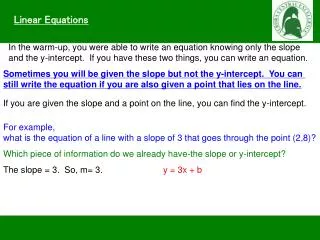
Find the Equation of the line: A line with slope (4/3) that passes through the point (-3,1).
You Try! Find the Equation of the line: A line with an x-intercept of -3 that passes through the point (1,4).
Special Relationships of Pairs of Lines Equation 1: Equation 2:
Special Relationships of Pairs of Lines Equation 1: Line that passes through (0,3) and (-3,4) Equation 2: Line that passes through (0,-2) and (-3, -1)
Two lines are parallel when they have the same slope. Parallel lines are coplanar lines that do not intersect
Determine if these pairs of lines are parallel. y = (-1/4)x + 2 and y = (-1/2)x + 2 y = 2x + 3 and y – 2 = 2(x + 1) 2x + 4y = 8 and y = (-1/2)x – 2 y – 1 = (1/5)(x – 0) and 1x – 6y = 6
Special Relationships of Pairs of Lines Equation 1: Equation 2:
Special Relationships of Pairs of Lines Equation 1: Line that passes through (0,-1) and (4,-2) Equation 2: Line that passes through (0,-4) and (1, 0)
Two lines are perpendicular when they have the opposite reciprocal slopes. Perpendicular lines are lines that intersect at a right angle.
Determine if these pairs of lines are perpendicular. y = (-2/3)x + 2 and y = (3/2)x + 1 y = 2x + 4 and y – 2 = (1/2)(x + 1) 4x – 2y = 8 and y = (-1/2)x – 2 y – 1 = (1/5)(x – 1) and 1x – 6y = 6