Download
1 / 27
270 likes | 362 Vues
Explore the impact of bias correction versus calibration on streamflow forecasting in the Western U.S., testing their effectiveness in reducing errors. The study evaluates various basins and different correction approaches, providing insights for operational settings.

E N D
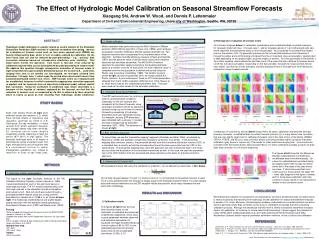
Effect of Model Calibration on Streamflow Forecast Results Ali Akanda, Andrew Wood, and Dennis LettenmaierCivil and Environmental EngineeringUniversity of WashingtonSeattle, WA
Problem Calibration is always a time-consuming and labor intensive part of modeling process. Automatic calibration routines are available but still not used widely. Has hampered implementation of models in different operational settings. • 1970s: ESP method developed in NWS • 2000s: ESP implemented in NWRFC s Question if operational water supply forecasting is mostly concerned with seasonal volumes, do we need to calibrate? Objective see whether bias-correction can achieve same goals as calibration in forecasting streamflow values
Contents • Domain • Calibration • Forecasts • Results • Summary
Domain • Western U.S. • Small-Medium • 1/8th degree • 9 being used • Mostly unimpaired
Calibration Manual • Visual comparison of averaged streamflow hydrographs Base State: NLDAS Parameters • Ds • Ds max • Ws • binf • Soil Depth [each layer]
North Fork FlatheadColumbia Falls, MTDrainage: 1548 sq. miles
Forecasts • ESP (Ensemble Streamflow Prediction) • 30 Ensembles for each run (1970-1999) • Forecasts for 25 different years: 1975-99 • Yearly forecasts run from January 1 / April 1 • Dry season streamflow average values (April-July and April-September)
Streamflow forecasts – Weber River Basin, UTApril 1 forecasts All error values are in cfs
Streamflow forecasts – White River Basin, COApril 1 forecasts All error values are in cfs
Streamflow forecasts - North Fork Flathead (NOFOR @ PNW)Error Values Jan 1 Forecasts Apr 1 Forecasts
Results • Bias Correction performed based on respective 25-year climatology (75-99) • Percent Anomaly • Rank Percentiles • Streamflow Error Values (averaged over ensembles / years) • MAE (Mean Average Error) • RMSE (Root Mean Squared Error)
Bias Corrected Streamflow forecasts Weber River Basin, UTApril 1 forecasts All error values are in cfs
Bias Corrected Streamflow forecasts Weber River Basin, UTApril 1 forecasts All error values are in cfs
Bias Corrected Streamflow forecasts White River Basin, COApril 1 forecasts All error values are in cfs
Bias Corrected Streamflow forecasts White River Basin, COApril 1 forecasts All error values are in cfs
Bias Corrected Streamflow forecasts N Flathead River , MTApril 1 forecasts All error values are in cfs
Bias Corrected Streamflow forecasts N Flathead River , MTApr 1 forecasts All error values are in cfs
Bias Corrected Streamflow forecasts White River Basin, COJan 1 forecasts All error values are in cfs
Bias Corrected Streamflow forecasts White River Basin, COJan 1 forecasts All error values are in cfs
Summary • Calibration helps to reduce the error of streamflow forecast results (expected) • Difference of Uncalibrated vs Calibrated forecast results greatly reduced if bias is removed by either method • Percentile-based bias correction performs better than anomaly-based bias correction • Error reduction from bias-correction similar to that achieved by calibration • Similar trends observed with both January 1 and April 1 forecasts
Work to be done • Comparison of forecast results with different initiation dates (Jan/ Apr 1) • Similar results for calibrated basins • Study even larger basins (Salmon?)