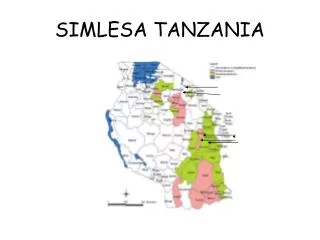
Advancing Sustainable Farming in Africa: Lessons from SIMLESA
The SIMLESA program addresses critical challenges in African agriculture, including low productivity, scarce biomass, and climate variability. By promoting conservation agriculture, improved crop varieties, and better market access, SIMLESA aims to boost maize and legume yields by 30%, benefitting over 650,000 households. The initiative encourages capacity building and partnerships to strengthen agricultural resilience across the region. Research gaps identified include integrated soil management and risk-reducing technologies, emphasizing the urgency of sustainable intensification in Africa's farming systems.

Advancing Sustainable Farming in Africa: Lessons from SIMLESA
E N D
Presentation Transcript
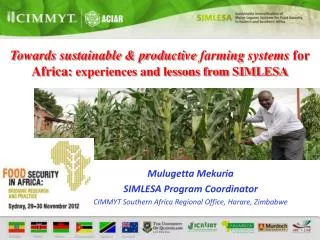
Towards sustainable & productive farming systemsfor Africa: experiences and lessons from SIMLESA Mulugetta Mekuria SIMLESA Program Coordinator CIMMYT Southern Africa Regional Office, Harare, Zimbabwe
The ProblemComplex Low productivity Scarcebiomass Land degradation Climate variability Poormarkets Limited resources Food insecurity
A Response: SIMLESA in action Mrs Grace Malaichi CHAMPION FARMER, MALAWI Within the CAADP framework, SIMLESA is increasing maize and legume yields by 30% through: Conservation agriculture practices Improved maize & legume varieties Better markets & value chains It will reduce yield risks by 30% Enhancing capacity & sustainability To benefit 650,000 households Facilitating spillovers to the region
SIMLESA Results on the Ground: Increasedmaizeyieldfrom CA in Malawi WET AREAS DRY AREAS Complexinteractions: Rainfall × Soil × Tillage × Residuecover × inputs etc
SIMLESA Results on the Ground: benefits of CA in Ethiopia 40% Higherreturns 54% Lowervariable costs
Scaling out: The weakest link in the R&D Continuum In country • Strengthening and replicating innovation platforms • Build technical capacity at all levels • Build capacity in partnership formation • Public private partnerships Across the region • Acceleratingspillovers across countries • Ethiopia/Kenya to Rwanda/Burundi/Uganda/South Sudan • Tanzania/Malawi/Mozambique to Zambia/Botswana
Further Research Gaps • Integrated soil fertility management for CA • Integration of crop-livestock systems for CA • Forage/fodder legumes • Post harvest technology, storage and processing, food quality • Policy options for sustainable intensification • Resilience enhancing and risk reducing technologies • Stress tolerant QPM • Herbicide resistant maize and legumes • Cell-phone based insurance
Take Home Messages • Sustainable intensification through CA in Africa is not only necessary but urgent • Phased intensification across farming systems • Focus on impact pathways, innovation platforms and systems integration