The Path to Peace: Ending World War I and Its Aftermath
By the end of 1916, World War I was marked by stalemate, low morale, and mounting casualties on all fronts. Economic hardships engulfed the homefront while Russia faced collapse. The U.S. joined the conflict in 1917, impacting post-war plans and shaping colonial ambitions. The Treaty of Versailles imposed heavy reparations on Germany and altered the geopolitical landscape. This overview discusses the major events leading to the armistice, the settlement negotiations, and the implications of the peace treaty, including the creation of new nations and the unresolved tensions in the Middle East.

The Path to Peace: Ending World War I and Its Aftermath
E N D
Presentation Transcript
Ending the War HWH UNIT 9 CHAPTER 14.3 and 14.4
By the End of 1916… • Stalemate on all fronts • Low morale • French troops mutiny • Russia on the verge of collapse • Economic hardships on the homefront • Millions already dead • AT THIS POINT, WHAT IS THE BEST WAY TO END THE WAR AND ENSURE A LASTING PEACE?
The US Joins the War • Post-War plans • Furthered colonial and imperial interests • Allies agreed to divide Ottoman Empire and Germany’s colonies • Germany had plans of colonial expansion • The Zimmerman Telegram • US Declares War (April, 1917)
The Role of Women French Munitions Workers
Nearly half of the labor force became female Filling the Roles of the Men
The Russian Revolution (1917) and the Treaty of Brest-Litovsk (1918)
The Collapse of the Central Powers • Germany • Civilian government vs. military • Austria-Hungary • Ethnic minorities • November 11, 1918
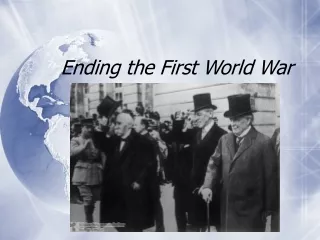
The Paris Peace Talks, 1919 The “Big Four” Lloyd George, Orlando, Clemenceau, and Wilson
Differing Agendas • Britain: a nation “fit for heroes,” maintain empires • France: Punish Germany • Italy: Land on the Adriatic • US: Lasting peace, collective security
Stipulations of the Treaty • Germany military reduced • Rhineland permanently demilitarized • Occupied for 15 years • Saar region controlled by League of Nations for 15 years • Reparations • $30 Billion • Germany forfeits all colonies • Article 231: The War Guilt Clause
Implications of the Treaty • Self Determination for some… • Colonies were redistributed • Germany humiliated • Diktat • The “Stab in the Back” • No foundation for lasting peace • New Map
Global Implications • The Middle East • Sykes-Picot Agreement (1916) • Divided the Middle East between France and Britain • New nations were arbitrarily created (Iraq, Syria, Lebanon, Jordan) • The Balfour Declaration (1917) • Britain promised the created of a Jewish state in Palestine • NO SELF-DETERMINATION FOR ARABS • Africa • Colonies and Mandates • NO SELF-DETERMINATION FOR AFRICANS