ENDOCRINE SYSTEM
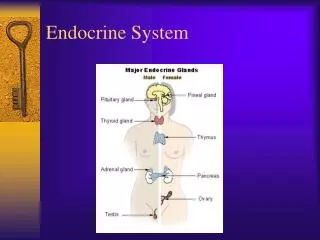
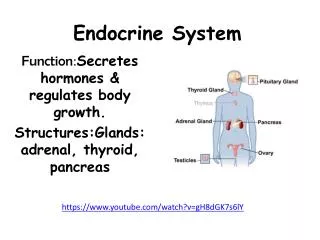
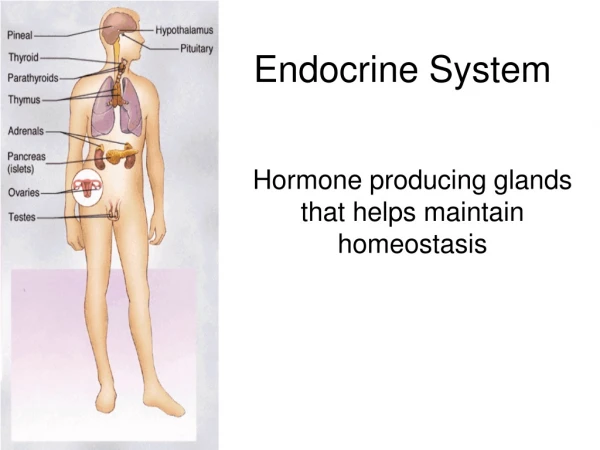
This comprehensive overview of the endocrine system covers the major glands, including the pituitary, thyroid, parathyroid, adrenal glands, and the pancreas. It outlines the functions of key hormones such as growth hormone, thyroid hormones, and insulin, highlighting their roles in growth, metabolism, water balance, and stress response. Abnormalities in hormone secretion, such as dwarfism, hyperthyroidism, and Cushing's syndrome, are also discussed, providing insights into various endocrine disorders and their symptoms.

ENDOCRINE SYSTEM
E N D
Presentation Transcript
1- PIUITARY GLAND a- Divisions: 1- Anterior pituitary: GH, prolactin, TSH ,ACTH ,FSH and LH. 2- Posterior pituitary: ADH and oxytocin.
GROWTH HORMONE (GH) • a-FUNCTIONS OF GROWTH HORMONE: • 1- Growth and development: indirect effect on bones (somatomedins). • 2- Metabolic functions; • i- Protein: anabolic. • ii- Lipids : lipolytic. • iii- Carbohydrates : hyperglycemic.
b- Abnormalities of GH secretion: 1- Hyposecretion: Dwarfism. 2- Hypersecretion : Gigantism and acromegaly.
Dwarfism Short stature Retarded soft tissue growth Proportionate rate of growth No mental retardation
Functions of posterior pituitary hormones: 1- ADH(vasopressin) 1- water reabsorption from kidneys. 2- vasoconstriction of blood vessels( most potent) 2- Oxytocin 1- uterine contraction. 2- milk ejection.
2- THYROID GLAND • a- Functions of T3 and T4: • 1- Calorogenic effect: increase O2 consumption. • 2- Metabolic effects: anabolic, lipolytic and hyperglycemic effects. • 3- CVS : increase HR, COP,ABP. • 4- GIT: increase appetite, secretion and motility. • 5- CNS: development and myelination of NS.
b- Abnormalities of thyroid gland: • 1- Hyperthyroidism: Grave,sdiasease. • 2- Hypothyroidism: • i- during childhood: cretinism. • Ii- during adulthood: myxedema.
Cretinism Swollen eyelid Depressed nose, wide nostrils Enlarged protruded tongue between two thick lips
Myxedematous swelling of the face Sparse hair
3- PARTHYROID GLANDS. • a- Functions of PTH (Hypercalcemic) • 1- Bone. • 2- Kidneys. • 3- GIT. • b- Effect of hyposecretion : (Tetany)
4- ADRENAL GLAND • a- Divisions: • 1- Adrenal cortex: Corticosteroids. • Aldosterone, cortisol and adrenal androgens. • 2- Adrenal medulla : Catecholamines.
Functions of corticosteroids ❇a- Aldosterone:increases blood sodium level and decreases blood potassium and hydrogen levels. ❇b- Cortisol: 1- Metabolic effects: catabolic, lipolytic and hyperglycemic. 2- Anti-allergic effect. 3- Anti- inflammatory effect. 4- Anti- stress effect.
Abnormalities o f adrenal cortical secretion: 1- Hypoadrenalism: Addison disease. 2- Hyperadrenalism : Cushing syndrome.
Sites of melanin pigmentation: 1)- Mucous membrane of lips &gums 2)- Skin ( pressure areas, aerola of the nipple) 3)- recent scars
Cushing syndrome Moon face Plethoric face Buffalo hump Abdominal obesity
Functions of catecholamines • The same effects like sympathetic nervous system • 1- Nervous system. • 2- Eyes. • 3- CVS. • 4- Respiration. • 5- Liver. • 6- Spleen
5- ENDOCRINE PANCREAS • Islets of Langerhans: • 1- Alpha cells: glucagon. • 2- Beta cells: insulin. • 3- Delta cells: somatostatin.
Functions of insulin • 1- Decreases blood glucose level (hypoglycemic effect) • 2- Increases lipid formation (lipogenic effect) • 3- Increases protein formation (anabolic effect)
Effect of insulin deficiency( Diabetes mellitus) Diabetes mellitus( DM) is manifested by: 1- Hyperglycemia. 2- Polyuria. 3- Polydipsia. 4- Polyphagia with weight loss.