Exploring Advanced Computational Project Topics: Group Expectations and Grading Criteria
In this project discussion led by Pat Burns on February 27, 2012, students are guided through expectations for individual or group projects, each graded at 35 points. Important factors influencing letter grades include project performance and homework results. The discussion also covers scaling up computational tasks on high-performance computing resources such as Cray and OLCF. Potential project topics range from molecular motion and parallel random number generation to advanced numerical methods and parallel computing techniques. Students may also consider industrial mentorship for project guidance.

Exploring Advanced Computational Project Topics: Group Expectations and Grading Criteria
E N D
Presentation Transcript
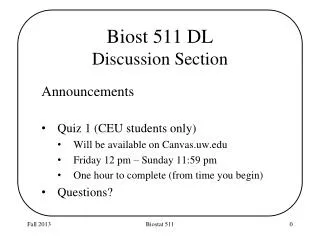
GRAD 511 Project Discussion Pat Burns February 27, 2012
Expectations • Projects can be individual or group • Projects will be graded at 35 points (3.5 x hw) • Likely grades on the rest of the homework and the project will determine letter grades • Scale up on our Cray • Then, scale up 10x on the OLCF • Can have an industrial mentor
PossibleTopics • Molecular motion • Parallel Random number generation • Monte Carlo particle transport • Monte Carlo integration of a "nasty" function • Discrete event simulation
Possible Topics (cont’d) • Gaussian elimination with pivoting • Conjugate gradient solution of linear algebraic equations SOR for a general, linear system of equations • Newton's method for a non-linear system of equations • Multigrid method for solving a system of PDE's on a grid • Advanced sorting, including alphanumeric data
Possible Topics (cont’d) • Parallel communication - fully exercise the machine • Parallel I/O • Co-array Fortran • PGAS (parallel global addressable system)environment • UPC (Unified Parallel C)
Possible Topics • GP GPU computing at OLCF • Visualization tools development