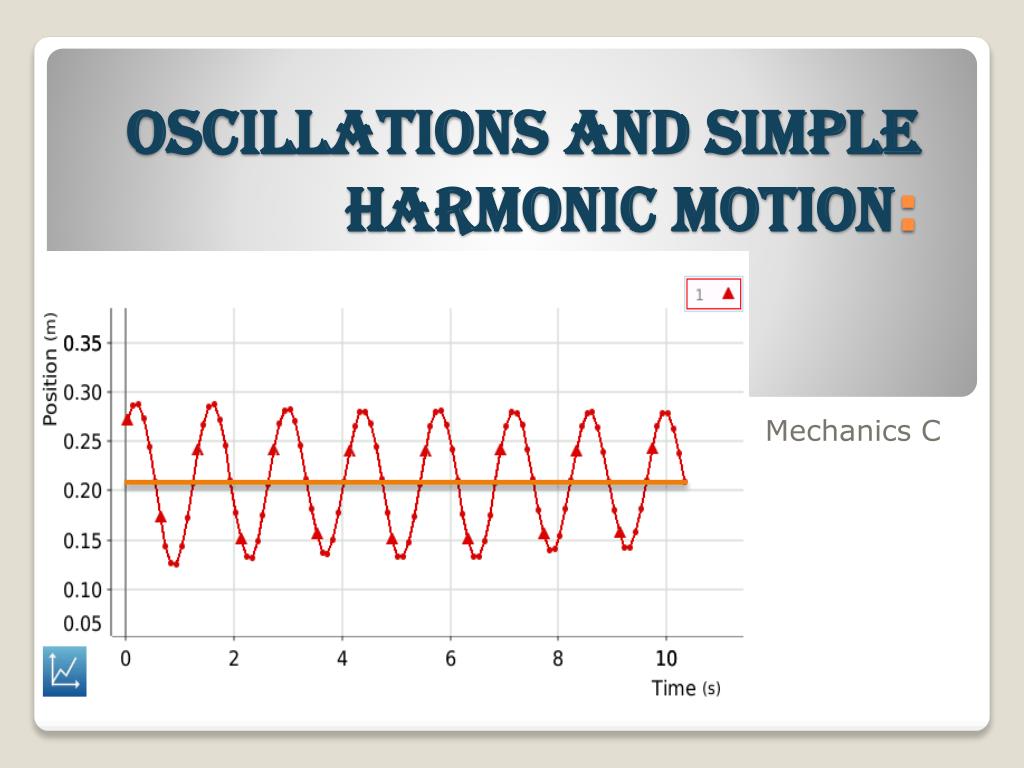
Oscillations and Simple Harmonic Motion :. Mechanics C . Oscillatory Motion is repetitive back and forth motion about an equilibrium position. Oscillatory Motion is periodic . Swinging motion and vibrations are forms of Oscillatory Motion .
Une image / un lien ci-dessous est fourni (tel quel) pour télécharger la présentation
Politique de téléchargement : le contenu du site vous est fourni TEL QUEL pour votre information et votre usage personnel ; il ne peut être vendu, concédé sous licence ni partagé sur d’autres sites sans l’accord de son auteur.Le contenu vous est fourni TEL QUEL, pour votre information et votre usage personnel uniquement.Téléchargez la présentation en cliquant sur ce lien.Lors du téléchargement, si vous ne parvenez pas à télécharger une présentation, l’éditeur a peut-être supprimé le fichier de son serveur.Pendant le téléchargement, si vous ne parvenez pas à obtenir une présentation, le fichier a peut-être été supprimé par l’éditeur.
Oscillatory Motion is repetitive back and forth motion about an equilibrium position Oscillatory Motion is periodic. Swinging motion and vibrations are forms of Oscillatory Motion. Objects that undergo Oscillatory Motion are called Oscillators. Oscillatory Motion
Here is what we want to do: DERIVE AN EXPRESSION THAT DEFINES THE DISPLACEMENT FROM EQUILIBRIUM OF THE SPRING IN TERMS OF TIME. Recall: Hooke’s Law WHAT DOES THIS MEAN? THE SECOND DERIVATIVE OF A FUNCTION THAT IS ADDED TO A CONSTANT TIMES ITSELF IS EQUAL TO ZERO. What kind of function will ALWAYS do this?
Phi is called the phase of the oscillation Phi naught is called the phase constant or phase shift. This value specifies the initial conditions. Different values of the phase constant correspond to different starting points on the circle and thus to different initial conditions The Phase Constant:
An object on a spring oscillates with a period of 0.8s and an amplitude of 10cm. At t=0s, it is 5cm to the left of equilibrium and moving to the left. What are its position and direction of motion at t=2s? Initial conditions: From the period we get:
Total mechanical energy is conserved for our SHM example of a spring with constant k, mass m, and on a frictionless surface. The particle has all potential energy at x=A and x=–A, and the particle has purely kinetic energy at x=0. We have modeled SHM mathematically. Now comes the physics.
At turning points: At x=0: From conservation: Maximum speed as related to amplitude:
a 500g block on a spring is pulled a distance of 20cm and released. The subsequent oscillations are measured to have a period of 0.8s. at what position or positions is the block’s speed 1.0m/s? The motion is SHM and energy is conserved.
Acceleration is not constant: According to Newton’s 2nd Law: As we found with energy considerations: This is the equation of motion for a mass on a spring. It is of a general form called a second order differential equation. Dynamics of SHM
Unlike algebraic equations, their solutions are not numbers, but functions. In SHM we are only interested in one form so we can use our solution for many objects undergoing SHM. Solutions to these diff. eqns. are unique (there is only one). One common method of solving is guessing the solution that the equation should have… From evidence, we expect the solution: 2nd-Order Differential Equations:
All objects have a natural frequency at which they tend to vibrate when disturbed. Objects may be exposed to a periodic force with a particular driving frequency. If the driven frequency matches the natural frequency of an object, RESONANCE occurs DrivenOscillations